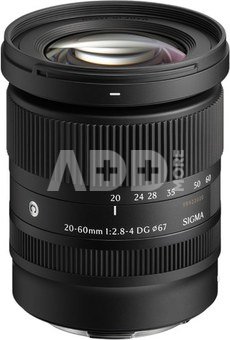
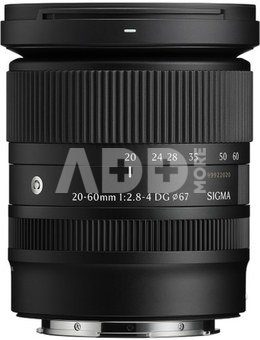
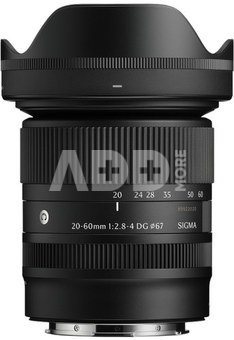
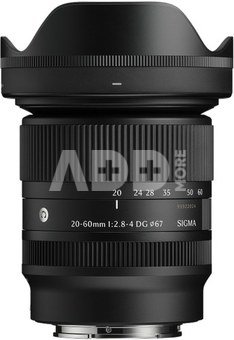
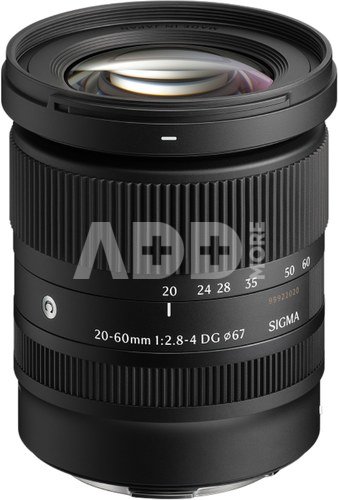
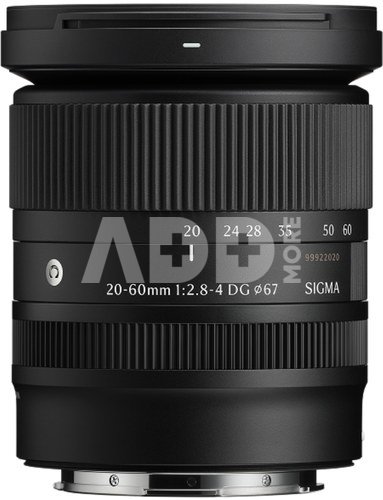
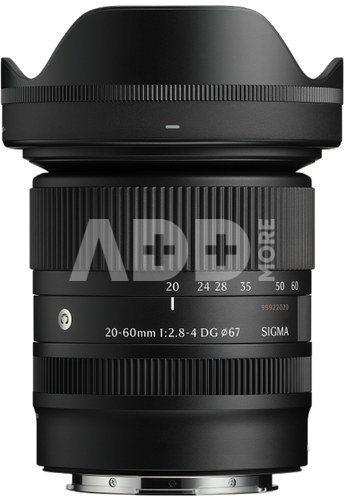
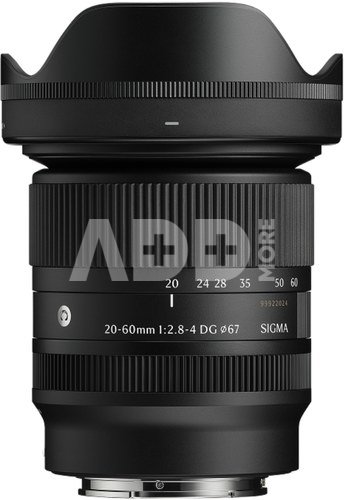
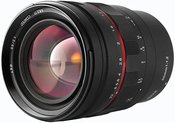
Sigma 20-60mm F2.8-4 DG Contemporary L-Mount is a compact and versatile full-frame zoom lens for L-Mount mirrorless cameras. Its distinctive 20–60mm focal length range covers everything from ultra-wide scenes to a more natural perspective, making it an excellent choice for travel, landscapes, architecture, interiors, street photography, everyday shooting and video content creation. The maximum aperture ranges from F2.8 at 20mm to F4 at 60mm, providing good low-light performance in a wide variety of shooting situations. A fast and quiet HLA linear focusing motor delivers precise autofocus for both stills and video, while the compact 385 g design makes the lens comfortable for everyday use.
Who is it for?
The Sigma 20-60mm F2.8-4 DG Contemporary is designed for photographers and video creators who need a lightweight and versatile everyday lens. The ultra-wide 20mm angle of view is particularly useful for landscapes, architecture, interiors and filming from close distances, while the 35–60mm range works well for street photography, portraits, travel and everyday situations.
It is a practical choice for users who want to cover more shooting scenarios with a single lens and reduce the amount of equipment they need to carry.
Key advantages
Versatile 20–60mm focal length range. The ultra-wide 20mm starting point offers greater creative freedom than traditional standard zoom lenses beginning at 24mm.
F2.8–4 aperture. The F2.8 maximum aperture at the wide end helps when shooting in lower light and gives greater control over background blur.
Fast HLA autofocus. The HLA linear motor provides fast, quiet and precise focusing for photography and video.
Compact and lightweight design. The L-Mount version weighs approximately 385 g, making it ideal for travel and everyday use.
Close focusing capability. The minimum focusing distance at 28mm is only 15.8 cm, while the maximum magnification reaches 1:2.3 at 35mm.
High optical quality. The optical construction incorporates 3 SLD and 3 aspherical elements to help reduce aberrations and maintain high image detail throughout the zoom range.
Dust- and splash-resistant construction. The lens is designed for use in varied conditions, while the front element features a water- and oil-repellent coating.
Comparison with alternatives
Compared with traditional 24–70mm zoom lenses, the Sigma 20-60mm F2.8-4 DG Contemporary offers a noticeably wider 20mm field of view, which is especially useful for architecture, interiors and landscape photography. On the other hand, its telephoto end reaches 60mm, so photographers who frequently need a longer focal length may prefer a 24–70mm lens.
The Sigma 20-60mm stands out for its compact size, low weight and ultra-wide starting focal length, making it an attractive option for travel and hybrid photo/video use.
FAQ
Is the Sigma 20-60mm F2.8-4 DG Contemporary suitable for full-frame L-Mount cameras?
Yes. The lens is designed for full-frame L-Mount mirrorless cameras.
Does the lens have image stabilization?
No. The lens does not feature built-in optical image stabilization.
What is the filter size?
The lens uses 67mm filters.
Is the lens suitable for video?
Yes. The quiet HLA focusing motor, low weight and wide 20mm field of view make it well suited for video content creation.
Specifications
Focal length: 20–60 mm
Maximum aperture: F2.8–4
Minimum aperture: F22–32
Mount: L-Mount
Sensor format: Full Frame
Optical construction: 15 elements in 13 groups
Special elements: 3 SLD, 3 aspherical
Diaphragm blades: 9
Minimum focusing distance: 15.8 cm at 28 mm
Maximum magnification: 1:2.3 at 35 mm
Filter size: 67 mm
Focusing system: HLA linear motor
Diameter: 72.2 mm
Length: 86 mm
Weight: 385 g
Protection: dust- and splash-resistant construction
Lens mount (bayonet)
L-mount
Type
zoom
Typ of SensorFull frame
Discuss with a consultant in Kaunas
We don't haveKlaipėdaAddress: Birželio 23-iosios g. 23gWorking hours: I-V 09:00 - 18:00VI-VII not workingPhone: +370 674 59488
Discuss with a consultant in Klaipėda
We don't haveKlaipėdaAddress: Taikos pr. 17Working hours: I-V 10:00 - 19:00VI 10:00 - 14:00VII not workingPhone: +370 604 43972
1. How to choose the right lens for a mirrorless camera?
When choosing the right lens for a mirrorless camera, it is important to consider your photography needs and style. First, decide on the resolution and focusing distance you require. For portraits, lenses with a wide aperture, such as a 50mm f/1.8, are often preferred. If you enjoy landscapes, go for a wide-angle lens (e.g., 24mm). To capture distant objects, telephoto lenses (e.g., 70-200mm) are useful. Another important factor is the lens’s light-gathering ability, which affects performance in low-light conditions. A stabilization system can also be important, especially for longer lenses. It’s important to evaluate the build quality of the lens and the manufacturer's reputation. Try out several lenses and consider your future needs to choose the right and long-lasting investment in your photography.
2. Are all lenses compatible with all mirrorless cameras?
Not all lenses are universal for all mirrorless cameras. Different manufacturers may have different mounts, so it is important to check the lens compatibility with your camera. For example, lenses for Canon, Nikon, Sony, and other manufacturers' mirrorless cameras may not be interchangeable without adapters. It is also important to consider the sensor size. APS-C lenses may be disproportionately large for full-frame cameras. Before purchasing a lens, it is advisable to check the manufacturer's compatibility chart and consider the specific requirements of your camera. Adapters can allow the use of third-party lenses, but there may be some loss in functionality or quality.
The website uses cookies, which help you ensure quality of service. Continuing browsing, you agree with fotoaparatas.eu cookies policy.Agree


.jpg)
.jpg)















Reviews
0 average rating (0 votes)