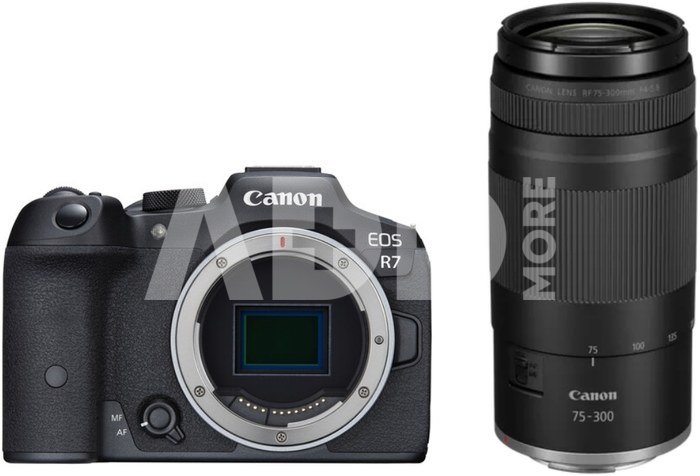
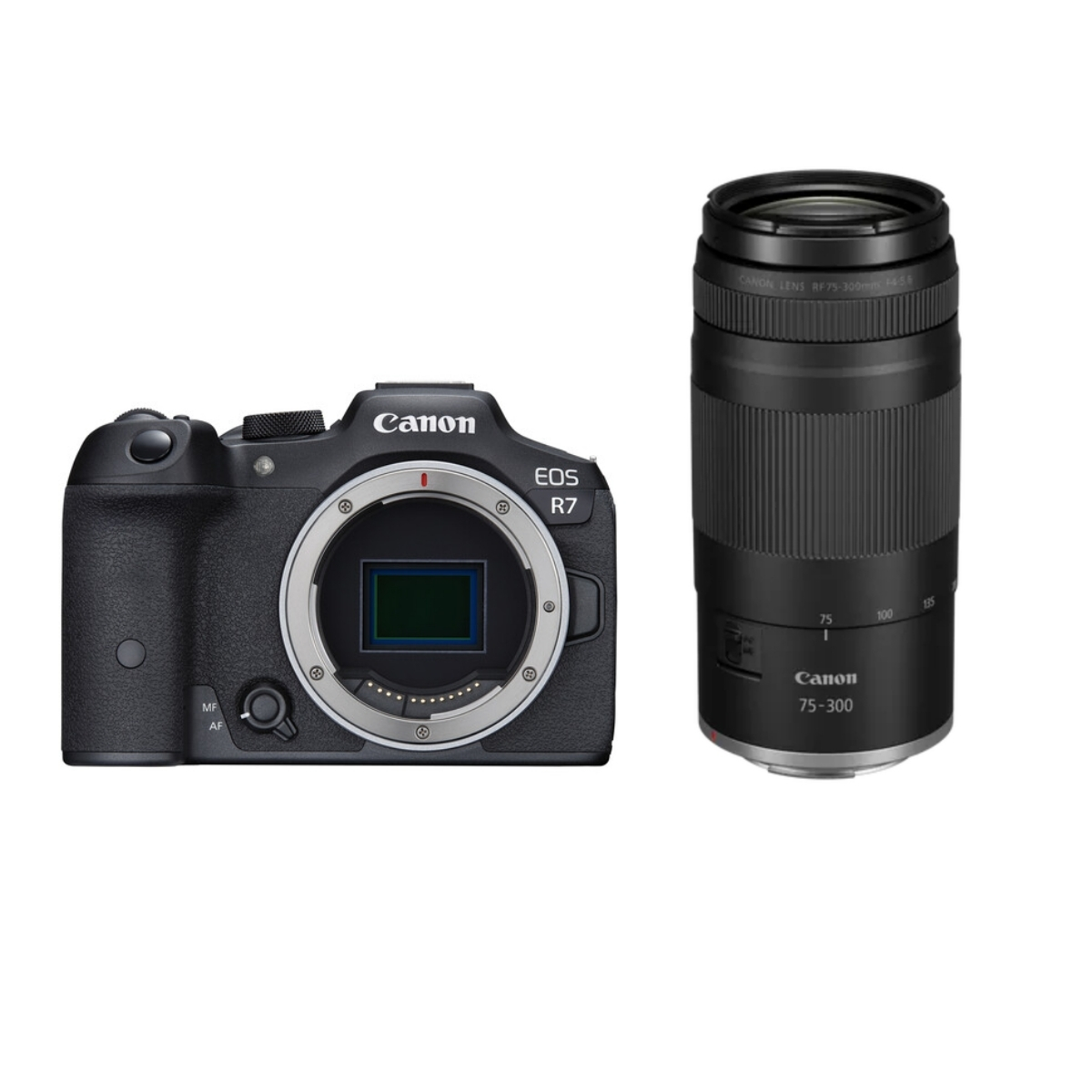
DescriptionCanon EOS R7 + Canon RF 75-300mm description
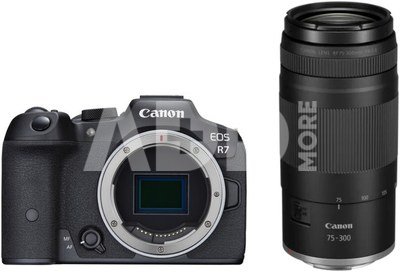
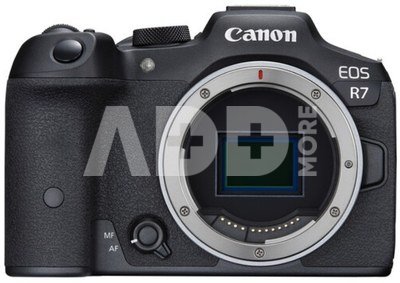
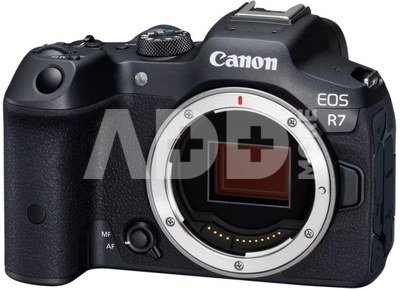
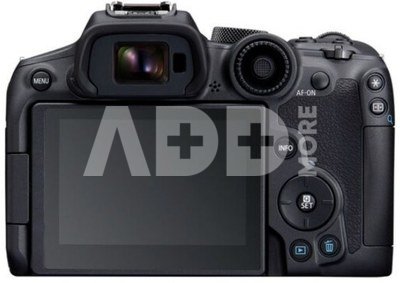
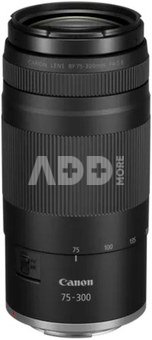
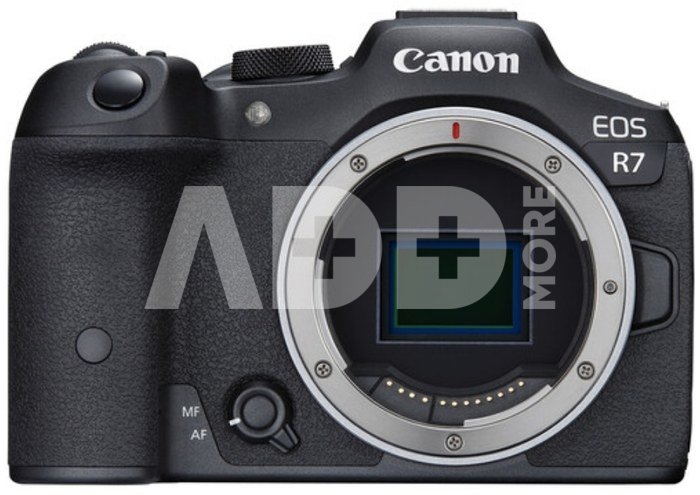
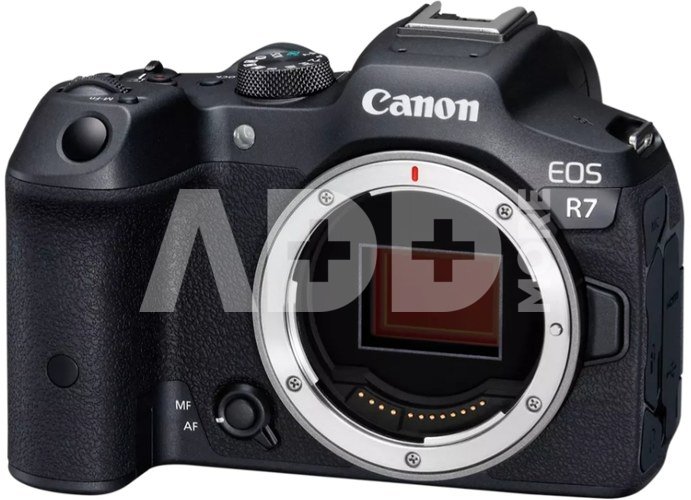
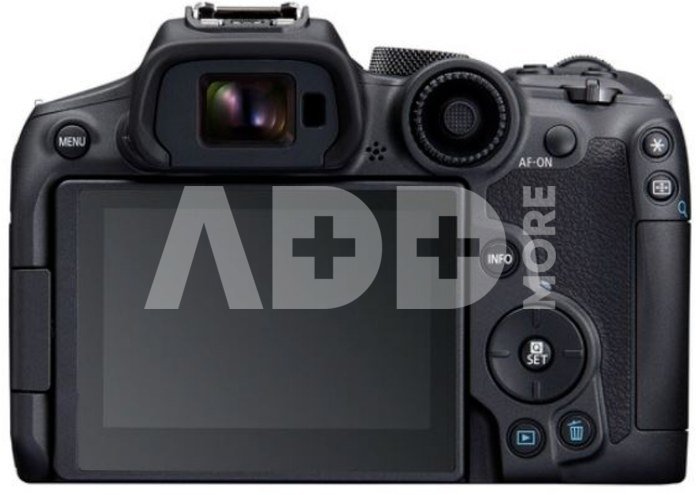
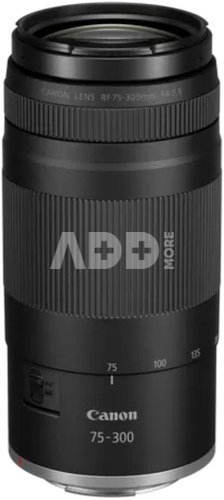
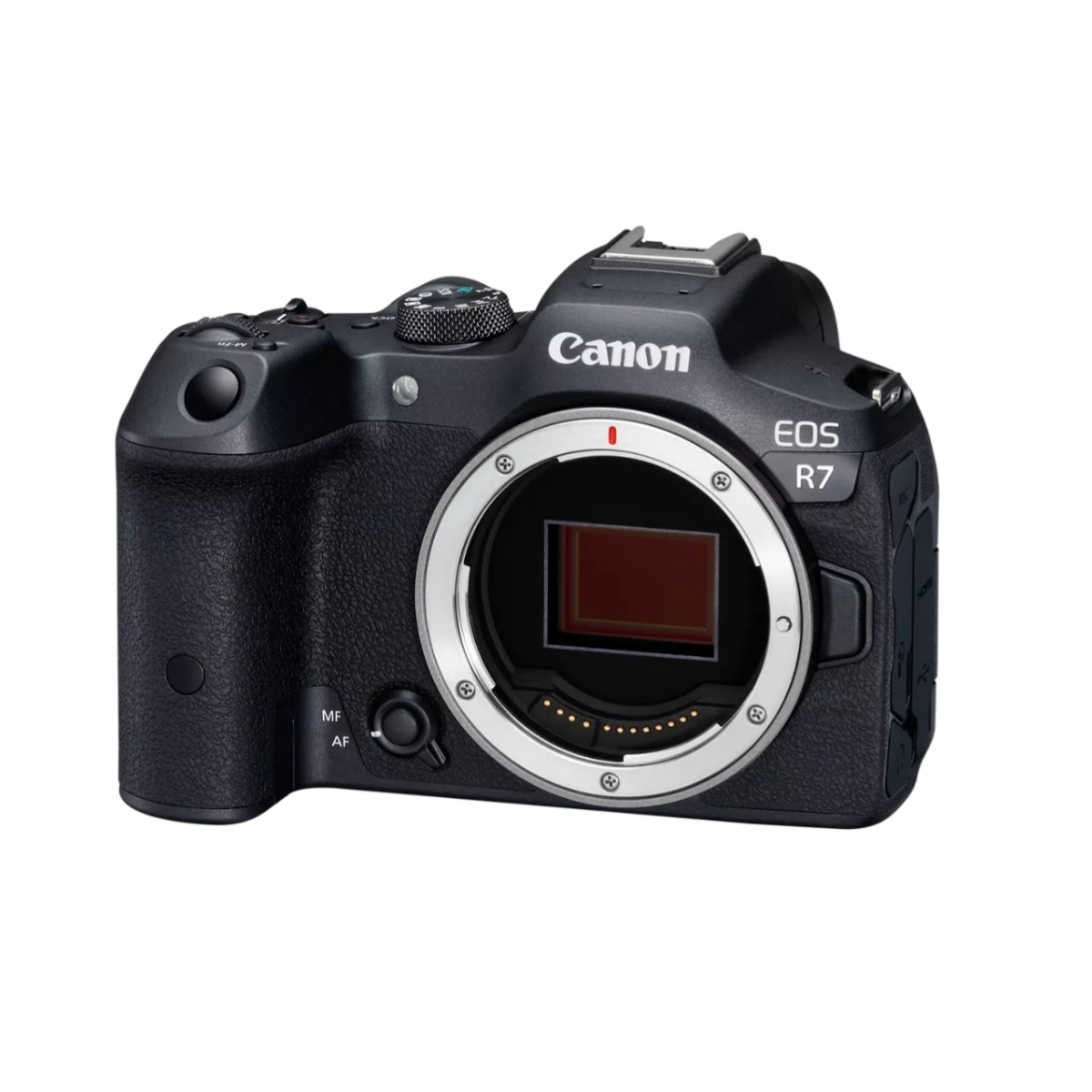
Canon EOS R7 + Canon RF 75-300mm F4-5.6 is a powerful APS-C interchangeable-lens camera and telephoto zoom kit designed for wildlife, bird, sports, aviation, motorsport, events and other types of long-distance photography. The Canon EOS R7 features a high-resolution 32.5 MP APS-C CMOS sensor, DIGIC X image processor and advanced Dual Pixel CMOS AF II autofocus. The camera can recognise and track people, animals and vehicles, while continuous shooting at up to 15 fps with the mechanical shutter and 30 fps with the electronic shutter helps capture fast and unpredictable action. The APS-C sensor provides a 1.6x crop factor, giving the Canon RF 75-300mm F4-5.6 a field of view equivalent to approximately 120-480mm on a full-frame camera. This extended reach is particularly useful when photographing birds, wildlife, athletes, aircraft and other subjects that are difficult to approach. The EOS R7 features 5-axis in-body image stabilisation, helping to reduce camera shake when shooting handheld. This is particularly useful with the RF 75-300mm F4-5.6 because the lens itself does not include optical image stabilisation. At approximately 507 g, the lens keeps the overall telephoto setup relatively portable. The camera is also well suited to video production, offering 4K UHD recording up to 60p, high-quality 4K Fine recording, Full HD up to 120p and Canon Log 3. A vari-angle touchscreen, electronic viewfinder, dual UHS-II SD card slots, Wi-Fi and Bluetooth provide additional flexibility for both photography and video.
Who is this kit for?
This kit is designed for photographers who need extended telephoto reach, fast autofocus and high image resolution. It is particularly suitable for wildlife and bird photography, sports, motorsport, aviation, events and travel.
It is an attractivechoice for users looking for a powerful APS-C camera and long telephoto range without immediately investing in considerably more expensive professional telephoto lenses.
Key advantages
32.5 MP APS-C CMOS sensor.
DIGIC X image processor.
Dual Pixel CMOS AF II.
People, animal and vehicle detection and tracking.
Up to 15 fps with mechanical shutter.
Up to 30 fps with electronic shutter.
5-axis in-body image stabilisation.
4K UHD video up to 60p.
Full HD up to 120p.
Canon Log 3.
RF 75-300mm F4-5.6 telephoto zoom.
Approx. 120-480mm full-frame equivalent field of view on the EOS R7.
Dual UHS-II SD card slots.
Vari-angle touchscreen.
Electronic viewfinder.
Wi-Fi and Bluetooth.
Approx. 507 g lens weight.
Comparison with alternatives
Compared with the Canon EOS R7 + RF-S 55-210mm F5-7.1 IS STM, the RF 75-300mm kit provides substantially more telephoto reach. On the EOS R7, the 75-300mm provides an approximately 120-480mm equivalent field of view, while the RF-S 55-210mm corresponds to approximately 88-336mm. The RF-S 55-210mm, however, is smaller and features optical image stabilisation and STM autofocus.
Compared with the Canon RF 100-400mm F5.6-8 IS USM, the RF 75-300mm is a simpler and more affordable option. The RF 100-400mm provides additional reach, approximately 160-640mm equivalent on the EOS R7, as well as optical stabilisation and a more advanced Nano USM autofocus system. It is therefore better suited to more demanding wildlife photographers.
Compared with the Canon EOS R10 + RF 75-300mm, the EOS R7 offers higher 32.5 MP resolution, in-body image stabilisation, dual memory card slots and a more advanced body. The EOS R10 is smaller and lighter, but the R7 is the stronger option for wildlife and sports.
FAQ
Is the Canon RF 75-300mm F4-5.6 compatible with the EOS R7?
Yes. The lens uses the Canon RF mount and is fully compatible with the EOS R7.
What focal length does the RF 75-300mm provide on the EOS R7?
The physical focal length remains 75-300mm, while the field of view corresponds to approximately 120-480mm on a full-frame camera.
Is this kit suitable for bird and wildlife photography?
Yes. The long telephoto reach, 32.5 MP resolution, fast autofocus and up to 30 fps continuous shooting make it highly suitable for wildlife and birds.
Does the RF 75-300mm F4-5.6 have image stabilisation?
No. The lens does not feature optical image stabilisation, but the EOS R7 has 5-axis in-body stabilisation.
Is this kit suitable for video?
Yes. The EOS R7 offers 4K UHD up to 60p, Full HD up to 120p and Canon Log 3. However, the RF 75-300mm uses a DC autofocus motor and is not as quiet or smooth as modern STM or Nano USM lenses.
SPECIFICATIONS
Canon EOS R7 camera
Type: interchangeable-lens system camera
Lens mount: Canon RF / RF-S
Sensor: APS-C CMOS
Sensor size: approx. 22.3 × 14.8 mm
Effective resolution: approx. 32.5 MP
Maximum image resolution: 6960 × 4640
Image processor: DIGIC X
Crop factor: 1.6x
Autofocus: Dual Pixel CMOS AF II
Subject detection: people, animals, vehicles
Automatic AF zones: up to 651
Image stabilisation: 5-axis in-body IS
ISO: 100-32000
Expanded ISO: up to 51200
Mechanical continuous shooting: up to 15 fps
Electronic continuous shooting: up to 30 fps
Mechanical shutter: up to 1/8000 sec.
Electronic shutter: up to 1/16000 sec.
Video: 4K UHD up to 60p
Full HD: up to 120p
Log profile: Canon Log 3
Viewfinder: OLED electronic viewfinder
Viewfinder resolution: approx. 2.36 million dots
Display: 3.0-inch vari-angle touchscreen LCD
Display resolution: approx. 1.62 million dots
Memory cards: 2 × SD / SDHC / SDXC
UHS-II: supported
Photo formats: JPEG, HEIF, RAW, C-RAW
Wireless: Wi-Fi, Bluetooth
USB: USB Type-C
HDMI: Micro HDMI
Microphone input: yes
Headphone output: yes
Battery: Canon LP-E6NH
Dimensions: approx. 132 × 90.4 × 91.7 mm
Weight: approx. 612 g with battery and memory card
Canon RF 75-300mm F4-5.6 lens
Mount: Canon RF
Format: full-frame / APS-C compatible
Focal length: 75-300mm
Equivalent field of view on EOS R7: approx. 120-480mm
Maximum aperture: f/4-5.6
Minimum aperture: f/32-45
Optical construction: 13 elements in 9 groups
Aperture blades: 7
Lens coating: Super Spectra Coating
AF drive: DC Motor, Gear Type
Minimum focusing distance: 1.5 m
Maximum magnification: 0.25x at 300mm
Optical image stabilisation: no
Filter diameter: 58 mm
AF/MF switch: yes
Weather sealing: no
Dimensions: approx. 71.2 × 146.1 mm
Weight: approx. 507 g
Lens hood: Canon ET-60, sold separately
RF 1.4x / 2x extenders: not compatible
Lens mount (bayonet)
Canon RF
Image Sensor Size
APS-C
Maximum Resolution6960 × 4640
Discuss with a consultant in Kaunas
We don't haveKlaipėdaAddress: Birželio 23-iosios g. 23gWorking hours: I-V 09:00 - 18:00VI-VII not workingPhone: +370 674 59488
Discuss with a consultant in Klaipėda
We don't haveKlaipėdaAddress: Taikos pr. 17Working hours: I-V 10:00 - 19:00VI 10:00 - 14:00VII not workingPhone: +370 604 43972
Specification
Producer(?)
Link to the official manufacturer website
Canon
Lens mount (bayonet)
Canon RF
Vaizdo sensorius
Image Sensor Size
APS-C
Maximum Resolution
6960 × 4640
Effective pixels
32.5 mln. pixels
Sensor type
CMOS
CPU Type
DIGIC X
Nuotrauka
ISO rating
ISO 100–32000, expandable to ISO 51200
Stabilization System
5 ašių stabilizatorius (5-Axis IBIS)
Image formats
Raw
, Jpeg
, HEIF
Fokusavimas
Focus
Yes
Focus Points
651
Manual Focus
Yes
Fotoaparato ypatumai
Shutter speed (sec)
30–1/8000 s mechanical; 30–1/16000 s electronic
Aperture Priority
Yes
Shutter Priority
Yes
Built-in flash
No
External Flash
Fast shooting
30 frames per second
Timer
Yes
Video įrašas
Video resolution
4K UHD (16:9) 3840 x 2160 (119.9, 100, 59.94, 50, 29.97, 25, 23.98 fps) 3 type of intra or Long GOP
, Full HD (16:9) 1920 x 1080 (239.76, 200, 119.9, 100, 59.94, 50, 29.97, 25, 23.98 fps) Intra frame or Long GOP
1. Which mirrorless camera should I choose for better photo results?
Choosing the right mirrorless camera for better photo results depends on your individual needs and budget. The Sony Alpha a7 III is a popular choice, offering excellent dynamic range and efficient autofocus. The Canon EOS R6 also boasts high technical performance, including powerful image stabilisation. The Nikon Z6 II is another attractive choice with excellent dynamic range and high ISO sensitivity. It's important to consider the features of each model, the choice of lenses and the ability to suit your shooting style. It is recommended to read reviews and test equipment before buying, if possible.
2. What are the advantages of mirrorless cameras compared to DSLR cameras?
The advantages of mirrorless cameras over DSLR cameras include modern technology and lightness. Mirrorless cameras are more compact and lighter, making them more comfortable to carry. They often have a smaller body because they do not have a mirror system, which reduces the overall weight. The use of an electronic viewfinder allows the actual frame to be seen before the picture is taken, thus optimising composition and exposure. Mirrorless cameras have fast autofocus and some models may perform better in low light conditions. They also offer more creative options, including a range of filters and effects. The new generation of lenses offers improved performance and efficiency, contributing to higher quality photos. However, every photographer's needs are different, so it is important to consider your preferences carefully before choosing a camera.
The website uses cookies, which help you ensure quality of service. Continuing browsing, you agree with fotoaparatas.eu cookies policy.Agree


















Reviews
0 average rating (0 votes)