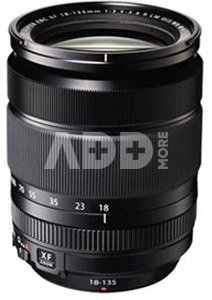
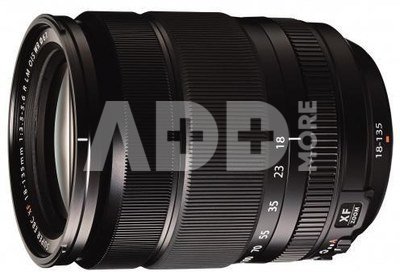
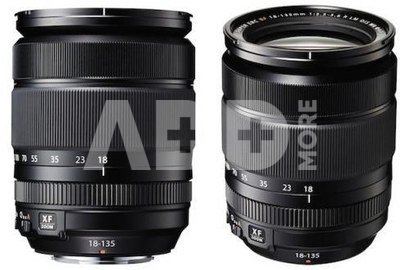
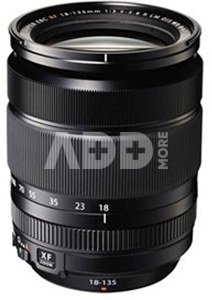
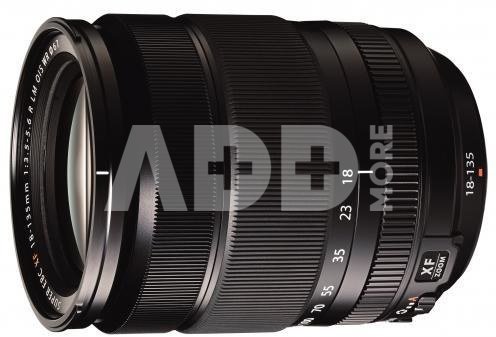
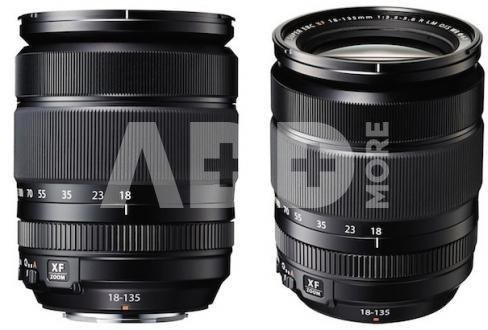
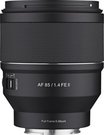
Objektyvas Fujifilm FUJINON XF18-135mm F3.5-5.6 R LM OIS WR
Covering a wide shooting range, from wide angles equivalent to 27 mm to telephoto 206 mm equivalent
The lens can be used for many subjects in various shooting scenes as it covers frequently used angles of view. These include wide angle, often used for shooting landscapes and architecture with an excellent sense of perspective (27 mm), a normal angle of view that naturally captures the image as is (35 mm, 40 mm, 50 mm), and telephoto, which symbolically cuts out portraits and sports scenes (85 mm, 135 mm, 200 mm with its 7.5× zoom.
In order to realize high descriptive performance with sharpness and rich contrast from wide angle to telephoto, high-performance glass materials including 4 aspherical glass lenses and 2 ED glass lenses are used. Multi-layer coating HT-EBC, which has high permeability (99.8%) and low reflectance (0.2%), is applied to the entire lens to effectively reduce lens flare and ghosting, which often occur in backlight conditions. Utilizing the wide zoom range of the lens, there is more freedom in composition and selecting angles.
Weather resistant structure
A weather resistant structure with applied sealing on 20 areas on the lens barrel is tough against various changes that occur in a natural environment, such as sudden rain, dust, and splashes of water.
In order to improve the feel when adjusting zoom, a ventilator is placed in the interior of the bottom of the lens barrel. The structure effectively prevents dust particles and moisture from getting into the lens to allow for smooth operation.
Fast autofocus, silent operation
The XF18-135mmF3.5-5.6 R LM OIS WR utilizes an inner focus mechanism for rapid autofocusing speeds. This was enabled by making the focus lens lighter and installing a linear motor. By combining this lens with the X-series camera body which is compatible with phase detection AF, smooth photography is offered with faster AF.
Linear motor technology which directly drives the focus lens creates low noise for silent operation when shooting movies.
World's most advanced 5.0-stop image stabilization function
In order to realize the world's most advanced 5.0-stop image stabilization performance, performance to detect movement in the low-frequency band was improved, and an algorithm to accurately sense blur from the detected signal was developed. Correction performance improved by 2 times in the low-speed shutter range. This helps to support a lightly-equipped shooting style without the use of a tripod.
The newly adopted high-precision gyro sensor is installed with quartz oscillators which detect movement from high frequency to low frequency bandwidth.
Light-weight and compact design for excellent mobility
A wide shooting range, image stabilization function, and a weather resistant structure are realized in a size that weighs only 490g. When combined with the FUJIFILM X-T1, a light weight of just 930g will expand the area of activities of the photographer to help capture more photo opportunities.
4 "aspherical lenses" have been adopted, each of which deliver the performance of multiple general spherical lenses together, are used to realize extremely short optical length. With an easily maneuverable size and good holding balance with the total lens length, a comfortable shooting style is promised.
Typ of Sensor
APS-C
Focal length Movie
18 mm
Image stabilization
Yra
Discuss with a consultant in Kaunas
We don't have
Klaipėda Address: Birželio 23-iosios g. 23g Working hours: I-V 09:00 - 18:00 VI-VII not working Phone: +370 674 59488
Discuss with a consultant in Klaipėda
We don't have
Klaipėda Address: Taikos pr. 17 Working hours: I-V 10:00 - 19:00 VI 10:00 - 14:00 VII not working Phone: +370 604 43972
1. How to choose the right lens for a mirrorless camera?
When choosing the right lens for a mirrorless camera, it is important to consider your photography needs and style. First, decide on the resolution and focusing distance you require. For portraits, lenses with a wide aperture, such as a 50mm f/1.8, are often preferred. If you enjoy landscapes, go for a wide-angle lens (e.g., 24mm). To capture distant objects, telephoto lenses (e.g., 70-200mm) are useful. Another important factor is the lens’s light-gathering ability, which affects performance in low-light conditions. A stabilization system can also be important, especially for longer lenses. It’s important to evaluate the build quality of the lens and the manufacturer's reputation. Try out several lenses and consider your future needs to choose the right and long-lasting investment in your photography.
2. Are all lenses compatible with all mirrorless cameras?
Not all lenses are universal for all mirrorless cameras. Different manufacturers may have different mounts, so it is important to check the lens compatibility with your camera. For example, lenses for Canon, Nikon, Sony, and other manufacturers' mirrorless cameras may not be interchangeable without adapters. It is also important to consider the sensor size. APS-C lenses may be disproportionately large for full-frame cameras. Before purchasing a lens, it is advisable to check the manufacturer's compatibility chart and consider the specific requirements of your camera. Adapters can allow the use of third-party lenses, but there may be some loss in functionality or quality.

















Reviews
0 average rating (0 votes)