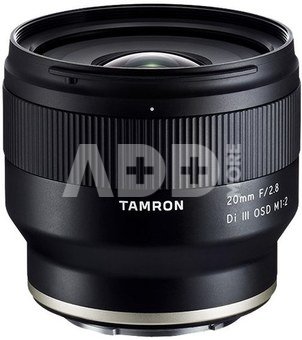
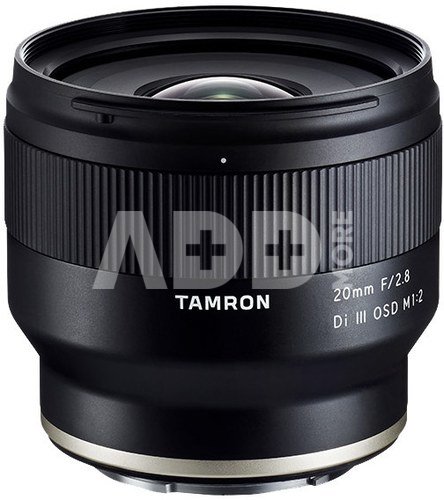
TAMRON 20MM F/2.8 DI III OSD M1:2 SONY FE
The 20mm F/2.8 Di III OSD M1:2 (Model F050) is fast handling and packs expressive power that is the signature of fixed focal lenses. It’s the ideal first ultra wide-angle lens for any photographer. It is designed exclusively for mirrorless cameras. Light weight and compact, the Model F050 is extremely portable, ideal for situations where you need to travel light. The Model F050 is a creative tool that dynamically captures scenery by maximizing the perspective unique to ultra wide-angle lenses. The incredibly short 0.11m (4.3 in) MOD (Minimum Object Distance) makes it possible to get closer to your subjects than you’d ever imagined. In addition to the F/2.8 aperture, the Model F050 is constructed using special glass materials including LD (Low Dispersion) and GM (Glass Molded Aspherical) lens elements effectively arranged to quash aberrations. The Model F050 provides outstanding optical performance across the entire frame, and delivers a sharp image, right down to the texture of the subject. With Moisture-Resistant Construction and dirt-resistant Fluorine Coating, photographers can shoot confidently outdoors. If you can own only one ultra wide-angle, the Model F050 should be your first choice.
Typ of Sensor
Full Frame
Image stabilization
Nėra
Delivery time
8-10 w.d.
Discuss with a consultant in Kaunas
We don't have
Klaipėda Address: Birželio 23-iosios g. 23g Working hours: I-V 09:00 - 18:00 VI-VII not working Phone: +370 674 59488
Discuss with a consultant in Klaipėda
We don't have
Klaipėda Address: Taikos pr. 17 Working hours: I-V 10:00 - 19:00 VI 10:00 - 14:00 VII not working Phone: +370 604 43972
1. How to choose the right lens for a mirrorless camera?
When choosing the right lens for a mirrorless camera, it is important to consider your photography needs and style. First, decide on the resolution and focusing distance you require. For portraits, lenses with a wide aperture, such as a 50mm f/1.8, are often preferred. If you enjoy landscapes, go for a wide-angle lens (e.g., 24mm). To capture distant objects, telephoto lenses (e.g., 70-200mm) are useful. Another important factor is the lens’s light-gathering ability, which affects performance in low-light conditions. A stabilization system can also be important, especially for longer lenses. It’s important to evaluate the build quality of the lens and the manufacturer's reputation. Try out several lenses and consider your future needs to choose the right and long-lasting investment in your photography.
2. Are all lenses compatible with all mirrorless cameras?
Not all lenses are universal for all mirrorless cameras. Different manufacturers may have different mounts, so it is important to check the lens compatibility with your camera. For example, lenses for Canon, Nikon, Sony, and other manufacturers' mirrorless cameras may not be interchangeable without adapters. It is also important to consider the sensor size. APS-C lenses may be disproportionately large for full-frame cameras. Before purchasing a lens, it is advisable to check the manufacturer's compatibility chart and consider the specific requirements of your camera. Adapters can allow the use of third-party lenses, but there may be some loss in functionality or quality.












![Sigma 10-18mm F2.8 DC DN [Contemporary] for Sony E-mount](https://www.fotoaparatas.eu/data/images/catalog_pics/n_thumb/sigma-10-18mm-f2-8-dc-dn-contemporary-for-sony-e-mount.jpg "Sigma 10-18mm F2.8 DC DN [Contemporary] for Sony E-mount")













Reviews
0 average rating (0 votes)