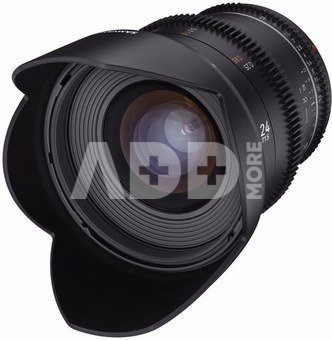
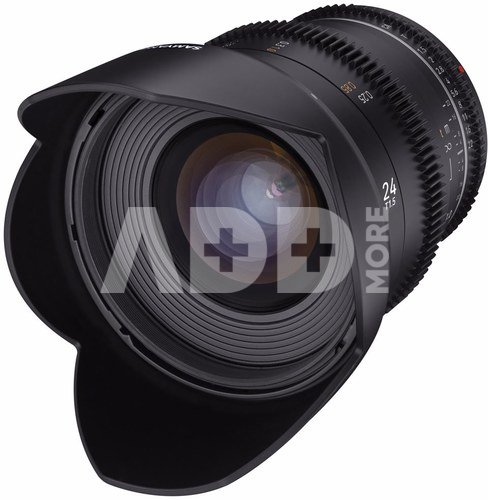
SAMYANG 24MM T1.5 VDSLR MK2 FUJI X
The Samyang VDSLR MK2 line-up is a series of affordable cine lenses with a professional feel. All lenses comes with enhanced weather sealing, focal lengths written on both sides, sleek design and 9 aperture blades (depending on model) that produces an stunning bokeh.Inheriting the Samyang's incredible cinematic video quality, this pioneering cine lens series will continuosly help independent filmmakers and low-budget project directors to broaden their horizons of creativity as their first cine lens set.The VDSLR MK2 series consists of all focal lenghts you need 14mm, 24mm, 35mm, 50mm, 85mm and 135mm. These provide angles which are essential for any creative or commercial projects.All lenses are available and fully compatible with 7 camera mounts: Canon EF, Sony E, Canon RF, Nikon F, Canon M, Fuji X and MFT. They are suitable for both DSLR and mirrorless systems and ready to support all types of filmmakers around the globe.In contrast to their compact size, the VDSLR MK2 lenses cover full-frame sensors (36x24mm) and are ready for the high-quality video making environment. This new series inherits the outstanding image quality of previous series: All lenses have aspherical lens elements to reduce spherical and optical aberration, producing clear and vibrant images.
Typ of Sensor
APS-C
Image stabilization
Nėra
Delivery time
11-14 w.d.
Discuss with a consultant in Kaunas
We don't have
Klaipėda Address: Birželio 23-iosios g. 23g Working hours: I-V 09:00 - 18:00 VI-VII not working Phone: +370 674 59488
Discuss with a consultant in Klaipėda
We don't have
Klaipėda Address: Taikos pr. 17 Working hours: I-V 10:00 - 19:00 VI 10:00 - 14:00 VII not working Phone: +370 604 43972
1. How to choose the right lens for a mirrorless camera?
When choosing the right lens for a mirrorless camera, it is important to consider your photography needs and style. First, decide on the resolution and focusing distance you require. For portraits, lenses with a wide aperture, such as a 50mm f/1.8, are often preferred. If you enjoy landscapes, go for a wide-angle lens (e.g., 24mm). To capture distant objects, telephoto lenses (e.g., 70-200mm) are useful. Another important factor is the lens’s light-gathering ability, which affects performance in low-light conditions. A stabilization system can also be important, especially for longer lenses. It’s important to evaluate the build quality of the lens and the manufacturer's reputation. Try out several lenses and consider your future needs to choose the right and long-lasting investment in your photography.
2. Are all lenses compatible with all mirrorless cameras?
Not all lenses are universal for all mirrorless cameras. Different manufacturers may have different mounts, so it is important to check the lens compatibility with your camera. For example, lenses for Canon, Nikon, Sony, and other manufacturers' mirrorless cameras may not be interchangeable without adapters. It is also important to consider the sensor size. APS-C lenses may be disproportionately large for full-frame cameras. Before purchasing a lens, it is advisable to check the manufacturer's compatibility chart and consider the specific requirements of your camera. Adapters can allow the use of third-party lenses, but there may be some loss in functionality or quality.






![Sigma 10-18mm F2.8 DC DN [Contemporary] for Fujifilm X-Mount](https://www.fotoaparatas.eu/data/images/catalog_pics/n_thumb/sigma-10-18mm-f2-8-dc-dn-contemporary-for-fujifilm-x-mount.jpg "Sigma 10-18mm F2.8 DC DN [Contemporary] for Fujifilm X-Mount")












Reviews
0 average rating (0 votes)