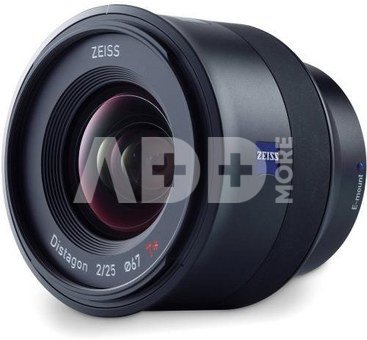
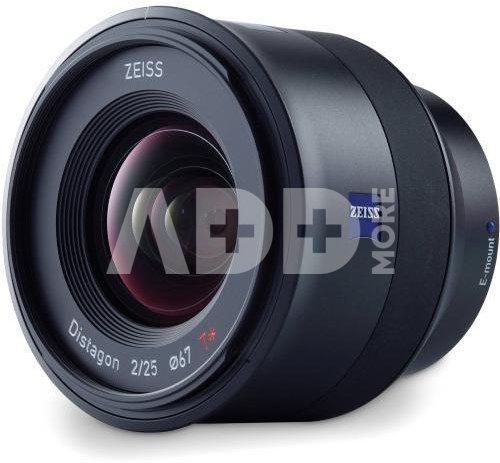
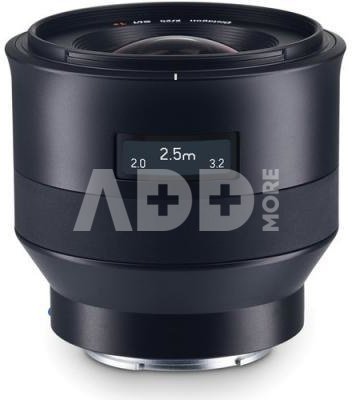
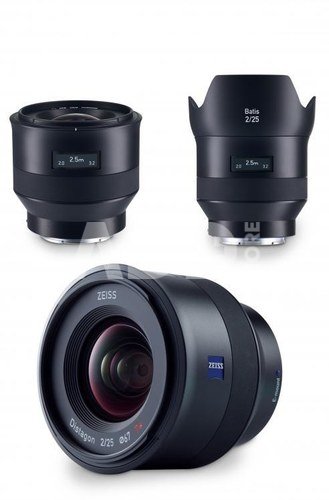
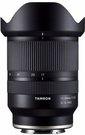
Objektyvas ZEISS Batis 2/25
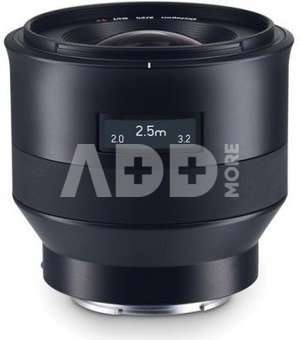
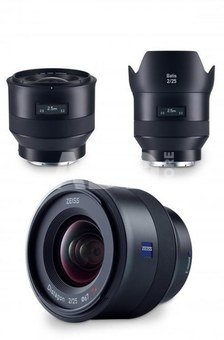
Wide angle lens with 10 elements in 8 groups. Four of the lenses are aspherical on both sides and five are made of special glass. The angle of 82 degrees and the closest focusing distance of only 0.2 meters, making this lens ideal for architectural and landscape photography. With its large depth of field gives it a new dimension to many subjects. Construction: Quick accurate autofocus, but also supports manual focus, so the user can easily choose the one that best suits the subject. Sleek modern design is familiar from Otus series and the lens delivers the right feel. The lens is equipped with an OLED display that shows the distance to the subject (from the focal plane) and the depth of field with the selected aperture. The lens is weather sealed.Technical data ZEISS Batis 2/25Focal length: 25 mmAperture range: f/2 - f/22Lens elements / groups: 10/8Focusing range: 0,2 m - infinityWorking distance: 0.13 m - infinityImage field (diag. / horiz. / vert.): 82°/ 72°/ 51°Image circle diameter: 43.3 mm Object field at minimum object distance : 12.4 x 18.7 cm Magnification ratio at minimum object distance: 1/5.2Filter thread: M67 x 0.75Diameter (max.): 81 mm Diameter of the focusing ring: 78 mm Length (without lens caps): 78 mm Length (with lens caps): 92 mm Weight (without lens caps): 335 g Camera mounts: E-mount
Focal length Movie
25 mm
Delivery time
5-19 w.d.
Focus
0.2m
Discuss with a consultant in Kaunas
We don't have
Klaipėda Address: Birželio 23-iosios g. 23g Working hours: I-V 09:00 - 18:00 VI-VII not working Phone: +370 674 59488
Discuss with a consultant in Klaipėda
We don't have
Klaipėda Address: Taikos pr. 17 Working hours: I-V 10:00 - 19:00 VI 10:00 - 14:00 VII not working Phone: +370 604 43972
1. How to choose the right lens for a mirrorless camera?
When choosing the right lens for a mirrorless camera, it is important to consider your photography needs and style. First, decide on the resolution and focusing distance you require. For portraits, lenses with a wide aperture, such as a 50mm f/1.8, are often preferred. If you enjoy landscapes, go for a wide-angle lens (e.g., 24mm). To capture distant objects, telephoto lenses (e.g., 70-200mm) are useful. Another important factor is the lens’s light-gathering ability, which affects performance in low-light conditions. A stabilization system can also be important, especially for longer lenses. It’s important to evaluate the build quality of the lens and the manufacturer's reputation. Try out several lenses and consider your future needs to choose the right and long-lasting investment in your photography.
2. Are all lenses compatible with all mirrorless cameras?
Not all lenses are universal for all mirrorless cameras. Different manufacturers may have different mounts, so it is important to check the lens compatibility with your camera. For example, lenses for Canon, Nikon, Sony, and other manufacturers' mirrorless cameras may not be interchangeable without adapters. It is also important to consider the sensor size. APS-C lenses may be disproportionately large for full-frame cameras. Before purchasing a lens, it is advisable to check the manufacturer's compatibility chart and consider the specific requirements of your camera. Adapters can allow the use of third-party lenses, but there may be some loss in functionality or quality.
















Reviews
5 average rating (1 rating)