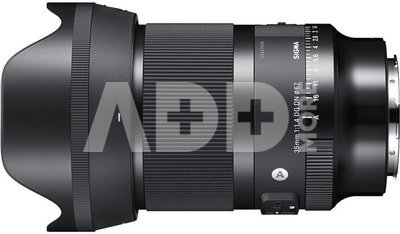
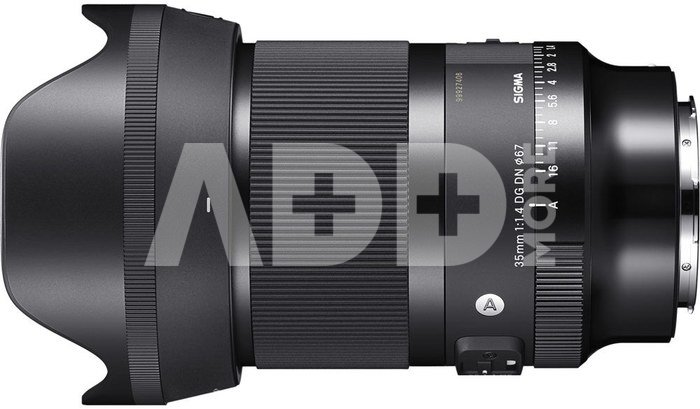
Sigma 35mm f/1.4 DG DN Art lens for L-mount
Central to the design of the 35mm F1.4 DG DN | Art is its sophisticated optical performance, which is consistent with the development of all Art line lenses. The lens incorporates 15 elements in 11 groups. With two Special Low Dispersion (SLD) elements, an Extraordinary Low Dispersion (ELD) element, an ‘F’ Low Dispersion (FLD) element and two aspherical elements, and as well as other high-performance glass, the lens’ advanced optical construction utilizes SIGMA’s state-of-the-art optical design technology, minimizing all types of aberration including axial chromatic aberration, which cannot be corrected in-camera.
In spite of having a very wide aperture of F1.4, the lens is able to control sagittal coma flare extremely well even wide open, stopping bright points of light from flaring out near the edges of the frame. This will be particularly appealing to night sky photographers.
Owing to its 11 rounded diaphragm blades, the lens displays smooth, round bokeh so that out-of-focus areas are not distracting. This makes the 35mm F1.4 DG DN | Art well-suited to portraits, supported by its ultra-sharp image quality and minimal color bleeding. It also performs very well in backlit conditions thanks to SIGMA’s anti-ghosting and anti-flare technology that it has cultivated through countless simulations and real-life testing in our many years of lens development. This keeps shots high contrast and free of excessive flare even when working in difficult light.
Typ of Sensor
Full Frame
Focal length Movie
35 mm
Image stabilization
Nėra
Discuss with a consultant in Kaunas
We don't have
Klaipėda Address: Birželio 23-iosios g. 23g Working hours: I-V 09:00 - 18:00 VI-VII not working Phone: +370 674 59488
Discuss with a consultant in Klaipėda
We don't have
Klaipėda Address: Taikos pr. 17 Working hours: I-V 10:00 - 19:00 VI 10:00 - 14:00 VII not working Phone: +370 604 43972
1. How to choose the right lens for a mirrorless camera?
When choosing the right lens for a mirrorless camera, it is important to consider your photography needs and style. First, decide on the resolution and focusing distance you require. For portraits, lenses with a wide aperture, such as a 50mm f/1.8, are often preferred. If you enjoy landscapes, go for a wide-angle lens (e.g., 24mm). To capture distant objects, telephoto lenses (e.g., 70-200mm) are useful. Another important factor is the lens’s light-gathering ability, which affects performance in low-light conditions. A stabilization system can also be important, especially for longer lenses. It’s important to evaluate the build quality of the lens and the manufacturer's reputation. Try out several lenses and consider your future needs to choose the right and long-lasting investment in your photography.
2. Are all lenses compatible with all mirrorless cameras?
Not all lenses are universal for all mirrorless cameras. Different manufacturers may have different mounts, so it is important to check the lens compatibility with your camera. For example, lenses for Canon, Nikon, Sony, and other manufacturers' mirrorless cameras may not be interchangeable without adapters. It is also important to consider the sensor size. APS-C lenses may be disproportionately large for full-frame cameras. Before purchasing a lens, it is advisable to check the manufacturer's compatibility chart and consider the specific requirements of your camera. Adapters can allow the use of third-party lenses, but there may be some loss in functionality or quality.


















Reviews
0 average rating (0 votes)