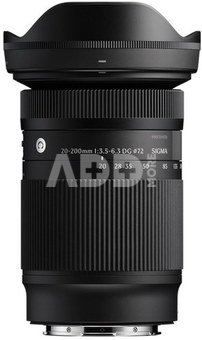
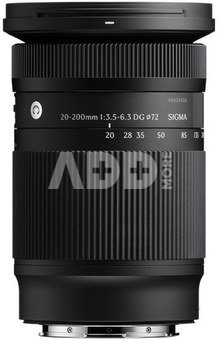
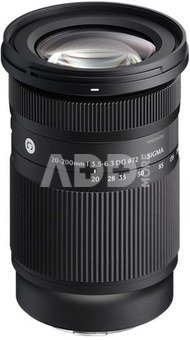
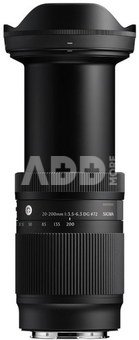
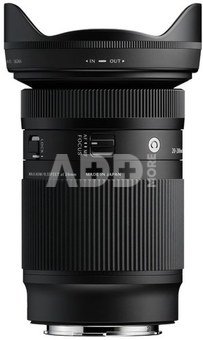
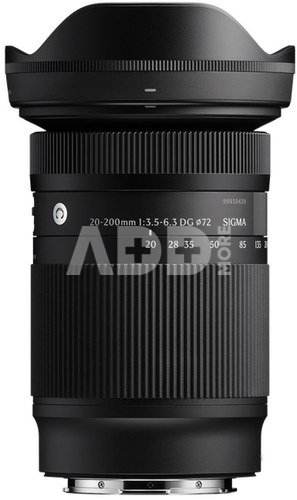
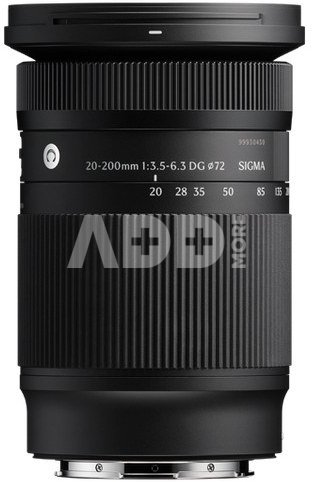
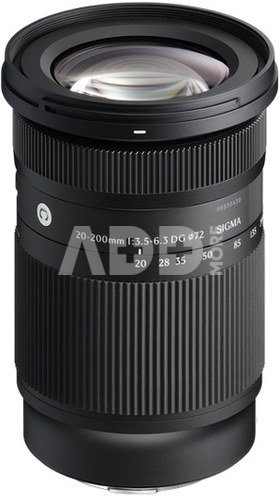
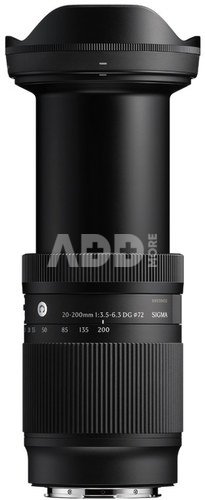
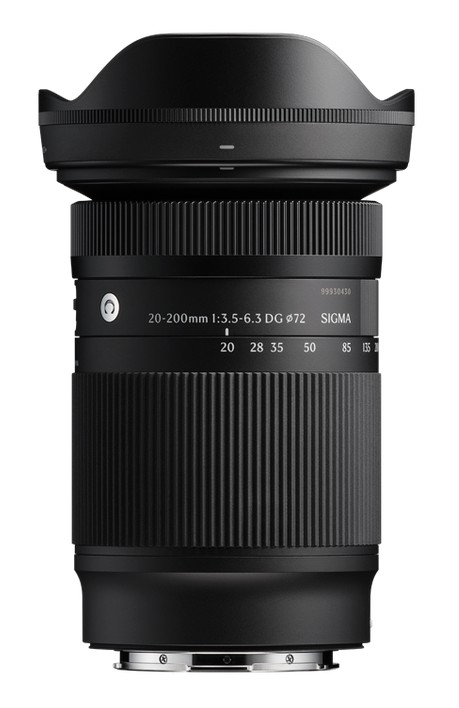
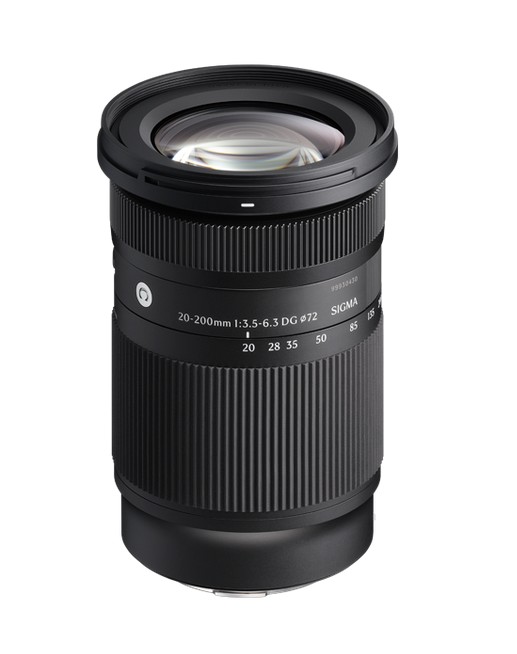
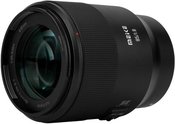
Sigma 20-200MM f/3.5-6.3 DG CONTEMPORARY L-MOUNT - an all-rounder that empowers limitless creativity. The world’s first*1 10x zoom starting at an ultra-wide 20mm. (*1 As of September 2025, by Sigma.). The Sigma 20–200mm F3.5–6.3 DG Contemporary is the world’s first high-power zoom lens for full-frame mirrorless cameras that achieves both 20mm at the wide end and a 10x zoom ratio. This versatile zoom lens covers everything from ultra-wide 20mm to telephoto 200mm, allowing photographers to capture subjects ranging from sweeping landscapes to fast-paced sports without being constrained by distance. Its flexibility makes it ideal for a wide variety of scenes, including close-ups with a maximum magnification ratio of 1:2. With its broad expressive capabilities, the lens truly shines in travel photography and everyday snapshots. The lens delivers a consistently comfortable shooting experience, with its thoroughly compact and lightweight design, as well as fast, accurate autofocus powered by a linear motor HLA (High-response Linear Actuator). The Sigma 20–200mm F3.5–6.3 DG Contemporary is the ultimate all-in-one zoom lens, offering all photographers unprecedented freedom and creativity. *1 As of September 2025, by Sigma.
ZOOM VERSATILITY MEETS EXPRESSIVE ULTRA-WIDE 20mm ― IN ONE LENS
The lens covers the ultra-wide angle of 20mm, which has been difficult to achieve with conventional high-power zoom lenses. Handling everything from majestic landscapes to sports, the lens perfectly captures both scenes unique to ultra-wide angles and applications that take advantage of its telephoto range. With a comprehensive zoom range of 20mm to 200mm, this ultimate all-in-one zoom lens delivers stunning details across a wide variety of shooting situations.
MAXIMUM MAGNIFICATION RATIO OF 1:2 AT THE FOCAL LENGTHS OF 28-85mm
The lens achieves a maximum magnification ratio of 1:2 at the focal lengths from 28mm to 85mm, enabling photographers to enjoy a broad range of half-macro photography with different angles of view, from wide macro shots that boldly incorporate the background by moving closer to the subject, to medium telephoto macro shots that highlight the subject at a natural distance.
OPTICAL AND MECHANICAL DESIGN REALIZING BOTH COMPACT SIZE AND HIGH PERFORMANCE
Incorporating high-refractive-index glass materials reduces lens movement during zooming. This enables a simple internal structure and slim lens body. The optical design, which properly positions four double-sided aspherical lenses, one FLD glass, and three SLD glass elements, combined with an internal mechanism that maintains high precision in each zoom group, also delivers high performance across the entire zoom range.
HLA-DRIVEN HIGH-SPEED AF
To help photographers capture even the most fleeting moments, the lens uses an HLA (High-response Linear Actuator) to achieve high-speed autofocus functionality with excellent drive accuracy.
DUST- AND SPLASH-RESISTANT STRUCTURE*1 AND WATER- AND OIL-REPELLENT COATING
In addition to a dust- and splash-resistant structure, the front element of the lens features a water- and oil-repellent coating, allowing photographers to shoot without concerns even in harsh outdoor environments. *1 The structure is designed to be dust- and splash- resistant, but not waterproof. Be careful not to bring the lens in contact with a large amount of water. Water inside the lens may cause major damage and even render the lens unrepairable.
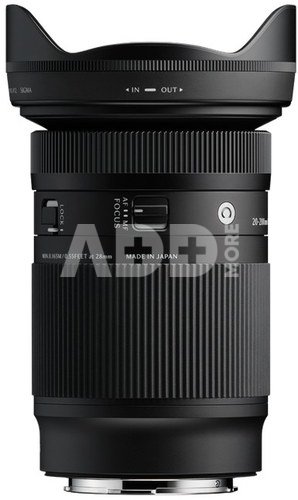
EQUIPPED WITH A ZOOM LOCK SWITCH AT THE WIDE END
The lens features a zoom lock switch that can be fixed at the wide end to prevent the lens from extending unintentionally under its own weight. The lock can be released not only by the switch but also via zoom operation, allowing for flexible handling of even impromptu shooting.
DESIGNED TO MINIMIZE FLARE AND GHOSTING
Flare and ghosting, which reduce image quality, are addressed under all conditions of incident light, based on the most advanced simulation technology. High backlight resistance enables clear and sharp images under any lighting conditions.
SPECIFICATIONS
Lens Mount: L-Mount
Sensor Format: Full-frame [DG]
Lens Construction: 18 elements in 14 groups (1 FLD, 3 SLD, 4 aspherical elements)
Angle of View: 94.5-12.3°
Number of Diaphragm Blades: 9 (Rounded Diaphragm)
Maximum Aperture: F3.5-6.3
Minimum Aperture: F22-40
Minimum Focusing Distance: 16.5 cm at f=28mm; 25 cm (W) - 65 cm (T)
Maximum Magnification Ratio: 1:2 at f=28-85mm
Filter Size: φ72mm
Dimensions (Diameter × Length): φ77.2 mm x 115.5 mm. *The length of a lens is measured from the front of the lens to its mount.
Weight: 550 g
Supplied Accessories: pouch, lens hood LH756-02, front cap LCF-72 IV, rear cap LCR III
Lens mount (bayonet)
L-mount
Typ of SensorFull frame
Focal length (wide)
20 mm
Discuss with a consultant in Kaunas
We don't haveKlaipėdaAddress: Birželio 23-iosios g. 23gWorking hours: I-V 09:00 - 18:00VI-VII not workingPhone: +370 674 59488
Discuss with a consultant in Klaipėda
We don't haveKlaipėdaAddress: Taikos pr. 17Working hours: I-V 10:00 - 19:00VI 10:00 - 14:00VII not workingPhone: +370 604 43972
1. How to choose the right lens for a mirrorless camera?
When choosing the right lens for a mirrorless camera, it is important to consider your photography needs and style. First, decide on the resolution and focusing distance you require. For portraits, lenses with a wide aperture, such as a 50mm f/1.8, are often preferred. If you enjoy landscapes, go for a wide-angle lens (e.g., 24mm). To capture distant objects, telephoto lenses (e.g., 70-200mm) are useful. Another important factor is the lens’s light-gathering ability, which affects performance in low-light conditions. A stabilization system can also be important, especially for longer lenses. It’s important to evaluate the build quality of the lens and the manufacturer's reputation. Try out several lenses and consider your future needs to choose the right and long-lasting investment in your photography.
2. Are all lenses compatible with all mirrorless cameras?
Not all lenses are universal for all mirrorless cameras. Different manufacturers may have different mounts, so it is important to check the lens compatibility with your camera. For example, lenses for Canon, Nikon, Sony, and other manufacturers' mirrorless cameras may not be interchangeable without adapters. It is also important to consider the sensor size. APS-C lenses may be disproportionately large for full-frame cameras. Before purchasing a lens, it is advisable to check the manufacturer's compatibility chart and consider the specific requirements of your camera. Adapters can allow the use of third-party lenses, but there may be some loss in functionality or quality.
The website uses cookies, which help you ensure quality of service. Continuing browsing, you agree with fotoaparatas.eu cookies policy.Agree
















Reviews
0 average rating (0 votes)