DescriptionNikon Z5 II + 24-50mm f/4-6.3 description
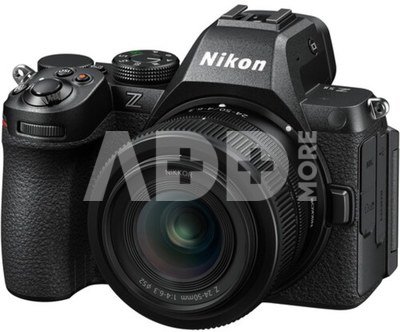
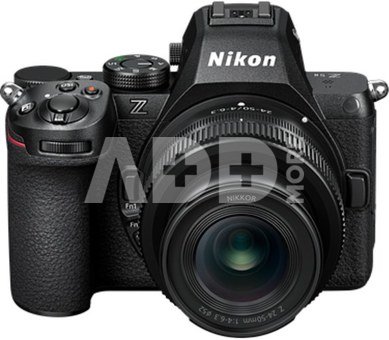
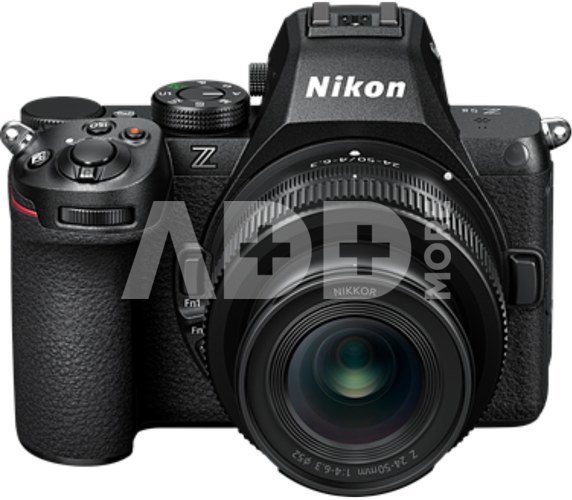
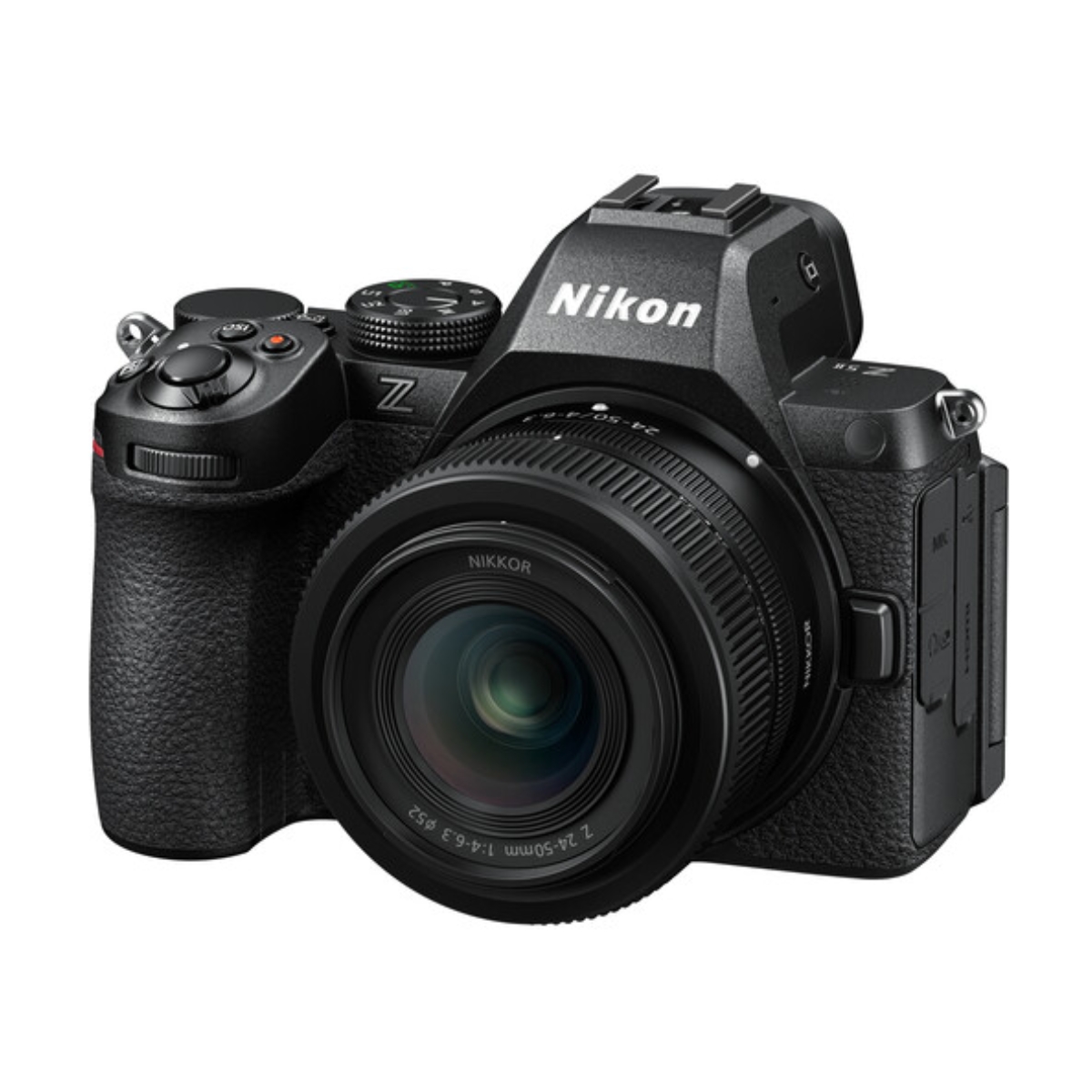
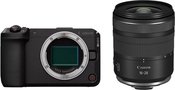
Nikon Z5 II + NIKKOR Z 24-50mm f/4-6.3 – Compact Full-Frame Kit for Everyday Use and Travel
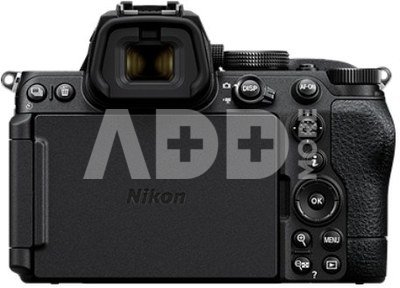
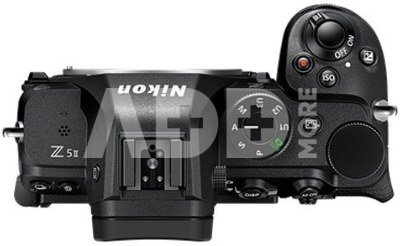
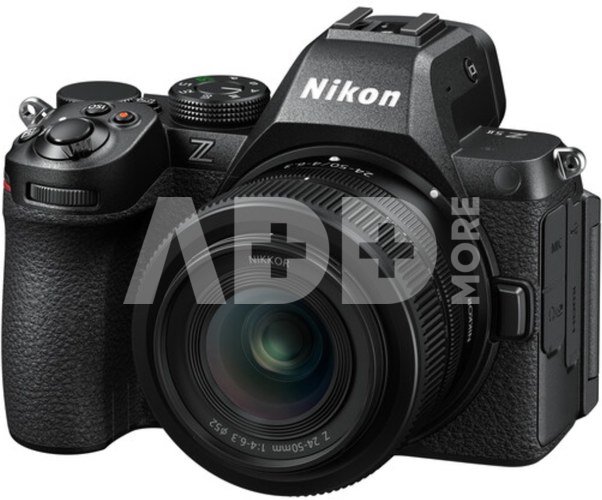
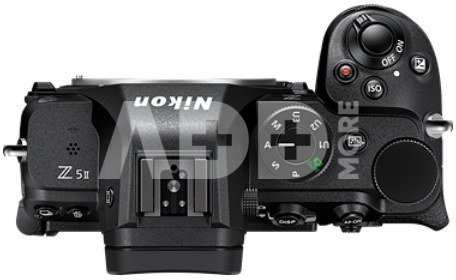
Nikon Z5 II + NIKKOR Z 24-50mm f/4-6.3 is a lightweight, compact and practical full-frame mirrorless camera kit for users who want to start shooting with the Nikon Z system without carrying large or heavy equipment. This kit combines the modern Nikon Z5 II camera body with a small standard zoom lens that is ideal for everyday photography, travel, city scenes, family moments, social media content and video creation.
It is a great choice if you want full-frame image quality but also want the camera to remain easy to carry. The 24–50mm focal length range covers the most commonly used angles: from wider travel or interior shots to natural portraits, street photography and everyday situations.
The Nikon Z5 II features a 24.5 MP full-frame FX sensor, the EXPEED 7 image processor, advanced autofocus, in-body image stabilisation and 4K video capabilities. Paired with the 24–50mm lens, it becomes a convenient first full-frame kit that is easy to take on a trip, to a photo session or simply use every day.
WHO IS IT FOR?
The Nikon Z5 II + 24-50mm f/4-6.3 kit is made for those who want a compact, easy-to-use and high-quality full-frame camera setup. It is an excellent option for a first full-frame camera, especially if you do not want to invest in larger or more expensive lenses right away.
This kit is especially suitable for:
– everyday photography;
– travel and city trips;
– family photos;
– street photography;
– landscapes and architecture;
– simple portraits;
– social media content;
– YouTube, Reels and short videos;
– beginners who want full-frame quality;
– Nikon DSLR users moving to mirrorless cameras.
If you are looking for a compact kit that is easy to start with, Nikon Z5 II + 24-50mm is a very practical choice.
KEY ADVANTAGES
Full-frame image quality in a smaller kit
The Nikon Z5 II gives you the benefits of a full-frame sensor: good detail, beautiful colours, wider dynamic range and more natural background blur than most smaller-sensor cameras.
Compact 24–50mm lens
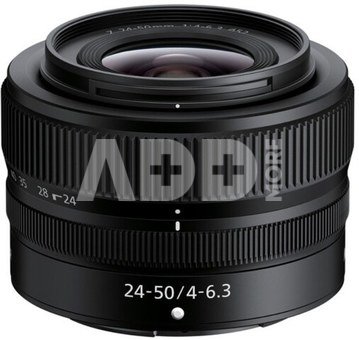
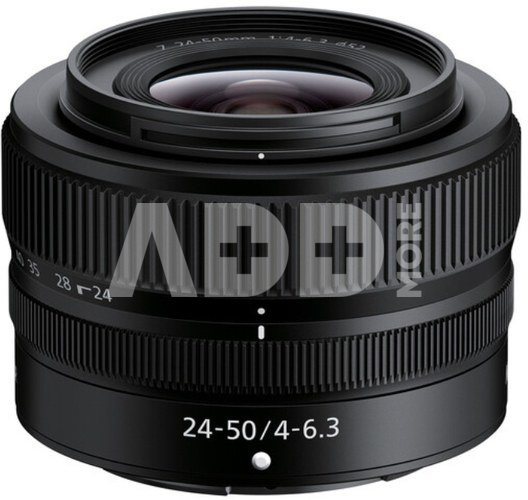
The NIKKOR Z 24-50mm f/4-6.3 is a small and convenient standard zoom lens. It is suitable for wide scenes, everyday shots, city views, travel and simple portraits.
A great start with the Nikon Z system
This kit allows you to start using the full-frame Nikon Z system without carrying a large or heavy setup. Later, you can add a brighter portrait lens, a telephoto lens or a wider-angle lens.
EXPEED 7 processor
The Nikon Z5 II uses the EXPEED 7 processor, which improves camera response, autofocus, subject detection, colour processing and video capabilities.
In-body stabilisation
Built-in image stabilisation helps when shooting handheld and makes video recording more convenient without additional equipment.
Good for travel
Thanks to the compact lens, this kit is easy to take into the city, on a plane, on a weekend trip or on a longer journey.
Photo and video in one camera
The Nikon Z5 II is suitable not only for photos but also for video creation. It is a good choice for content creators who want one camera for everyday photos and social media videos.
WHY CHOOSE THE 24-50MM KIT?
The biggest advantage of this kit is compact size. The 24–50mm lens does not take up much space, so the camera remains comfortable to carry and use every day.
The 24mm position is suitable for:
– travel;
– architecture;
– interiors;
– group photos;
– wider city scenes;
– handheld video.
The 50mm position is suitable for:
– portraits;
– everyday shots;
– details;
– street photography;
– a more natural perspective;
– content creation.
This is not a long-zoom lens, but it covers a very commonly used focal length range. That makes it especially suitable for users who want a light, simple and high-quality start.
HOW DOES IT PERFORM IN REAL LIFE?
In everyday use, this kit is very convenient because of its size. It is easy to take on a walk, trip, event or family meeting. The camera gives you full-frame quality, while the lens remains small and simple to use.
When travelling, the 24mm focal length helps capture wider scenes – cities, buildings, landscapes or interiors. The 35–50mm range is suitable for people, street shots, food, details and simple portraits. It is a very natural range for everyday use.
This kit is also good for beginners because you do not need to decide immediately which extra lenses you need. With the 24–50mm lens, you can learn the basic focal lengths, understand your shooting habits and later choose your next lens more clearly.
NIKON Z5 II + 24-50MM OR BODY ONLY?
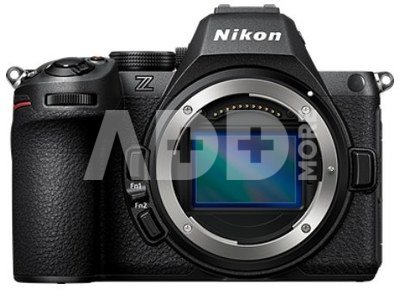
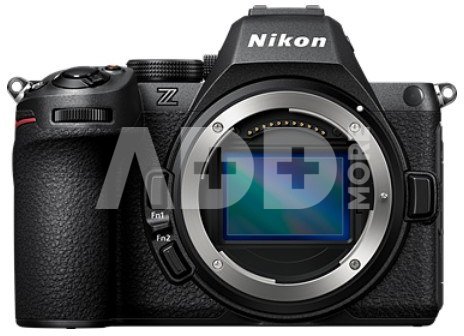
Choose Nikon Z5 II Body if you already own Nikon Z lenses or plan to buy specific lenses right away based on your shooting style.
Choose Nikon Z5 II + NIKKOR Z 24-50mm f/4-6.3 if you want a light, compact and ready-to-use kit immediately. It is a good solution for a first full-frame camera when you want to start simply and avoid a heavier setup.
NIKON Z5 II + 24-50MM OR 24-70MM F/4 S KIT?
The 24-50mm kit is smaller, lighter and simpler. It is better for travel, everyday use and users who want a compact full-frame kit.
The 24-70mm f/4 S kit is a more serious choice for those who want higher optical quality, a constant f/4 aperture and a more versatile working range. It is better for portraits, events, video and more intensive use.
If compact size is most important, choose the 24–50mm. If optical quality and wider possibilities matter more, choose the 24–70mm f/4 S.
NIKON Z5 II + 24-50MM OR 24-200MM KIT?
The 24-50mm kit is lighter and more compact. It is good for users who mainly photograph cities, travel, people, family and everyday situations.
The 24-200mm kit provides much more zoom reach and is better for travel when you want one lens for almost everything – from wide landscapes to distant subjects.
If you want a smaller and lighter kit, the 24–50mm is a practical choice. If you want the most flexible zoom range, the 24–200mm is the more versatile option.
WHAT SHOULD YOU CONSIDER?
The NIKKOR Z 24-50mm f/4-6.3 is very compact and convenient, but it is not designed for long zoom reach or very strong background blur. If you often shoot portraits, events or in low light, it may be worth adding a brighter prime lens later, such as a 35mm, 50mm or 85mm.
Also, if you often photograph sports, wildlife or distant subjects, you may need a telephoto lens. However, as a first lens and a lightweight everyday solution, the 24–50mm is very convenient.
IS IT WORTH BUYING?
Yes, the Nikon Z5 II + NIKKOR Z 24-50mm f/4-6.3 is worth buying if you want a light, compact and high-quality full-frame kit for everyday use, travel and your first step into the Nikon Z system.
This kit is worth choosing if:
– you want your first full-frame camera;
– compact size is important to you;
– you travel often;
– you do not want to buy larger lenses right away;
– you photograph everyday situations, people, cities and family;
– you create social media content;
– you want an easy start with the Nikon Z system.
It is one of the most convenient Nikon Z5 II kits for users who want full-frame quality without a large and heavy setup.
FREQUENTLY ASKED QUESTIONS (FAQ)
Does this kit include a lens?
Yes, this kit includes the Nikon Z5 II camera body and the NIKKOR Z 24-50mm f/4-6.3 lens.
What is the NIKKOR Z 24-50mm f/4-6.3 lens suitable for?
This lens is suitable for travel, street photography, everyday photos, family, city scenes, interiors and simple portraits.
Is Nikon Z5 II + 24-50mm suitable for beginners?
Yes, it is a very good choice for beginners who want to start with a full-frame camera and a compact universal lens.
Is this kit good for travel?
Yes, this kit is excellent for travel because the lens is compact, light and covers the most commonly used focal length range.
Is the 24-50mm lens good for portraits?
Yes, the 24-50mm lens can be used for portraits, especially at the 50mm position. For stronger background blur, a bright prime lens is recommended later.
How is the 24-50mm kit different from the 24-70mm f/4 S kit?
The 24-50mm kit is more compact and lighter. The 24-70mm f/4 S kit offers higher optical quality, a constant f/4 aperture and a wider working range.
How is the 24-50mm kit different from the 24-200mm kit?
The 24-50mm kit is smaller and lighter, while the 24-200mm gives much more zoom reach and more flexibility when travelling.
Can other Nikon Z lenses be used with this camera?
Yes, the Nikon Z5 II is compatible with Nikon Z mount lenses. Nikon F mount lenses can also be used with a compatible adapter, although some restrictions may apply.
SPECIFICATIONS
Type: Digital camera with support for interchangeable lenses
Lens mount: Nikon Z mount
Compatible lenses: Z mount NIKKOR lenses. F mount NIKKOR lenses (mount adapter required; restrictions may apply).
Effective pixels: 24.5 million
Image sensor type: 35.9 × 23.9 mm CMOS sensor (full-frame/FX-format)
Total pixels: 25.28 million
Dust-reduction system: Image sensor cleaning, Image Dust Off reference data (requires NX Studio)
File format (image quality): NEF (RAW): 14 bit; choose from lossless compression, high efficiency (high), and high efficiency options. JPEG: JPEG-Baseline compliant with fine (approx. 1 : 4), normal (approx. 1 : 8), or basic (approx. 1 : 16) compression; size-priority and optimal-quality compression available. HEIF: Supports fine (approx. 1 : 4), normal (approx. 1 : 8), or basic (approx. 1 : 16) compression; size-priority and optimal-quality compression available. NEF (RAW)+JPEG: Single photograph recorded in both NEF (RAW) and JPEG formats. NEF (RAW)+HEIF: Single photograph recorded in both NEF (RAW) and HEIF formats.
Picture Control System: Auto, Standard, Neutral, Vivid, Monochrome, Flat Monochrome, Deep Tone Monochrome, Portrait, Rich Tone Portrait, Landscape, Flat, Creative Picture Controls (Dream, Morning, Pop, Sunday, Somber, Dramatic, Silence, Bleached, Melancholic, Pure, Denim, Toy, Sepia, Blue, Red, Pink, Charcoal, Graphite, Binary, Carbon); selected Picture Control can be modified; storage for Custom Picture Controls. * Note: Choice of Picture Controls is restricted to Standard, Monochrome, and Flat when HLG is selected for tone mode during still photography.
Memory card: SD (Secure Digital), SDHC, and SDXC memory cards (SDHC and SDXC memory cards are UHS‑II compliant)
Dual card slot: 2 Secure Digital (SD) cards. Either card can be used for overflow or backup storage, for separate storage of NEF (RAW) and JPEG or HEIF pictures, or for storage of duplicate JPEG or HEIF pictures at different sizes and image qualities; pictures can be copied between cards.
File system: DCF 2.0, Exif 2.32, MPEG‑A MIAF
Viewfinder: 1.27-cm/0.5-in. approx. 3690k-dot (Quad VGA) OLED electronic viewfinder with color balance and auto and 18-level manual brightness controls
Frame coverage: Approx. 100% horizontal and 100% vertical
Magnification: Approx. 0.8× (50 mm lens at infinity, −1.0 m−1)
Eyepoint: 21 mm (−1.0 m−1; from rearmost surface of viewfinder eyepiece lens)
Diopter adjustment: −4 – +2 m−1
Eye sensor: Automatically switches between monitor and viewfinder displays
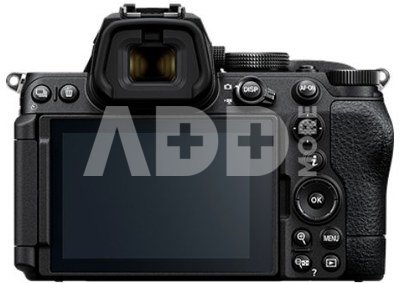
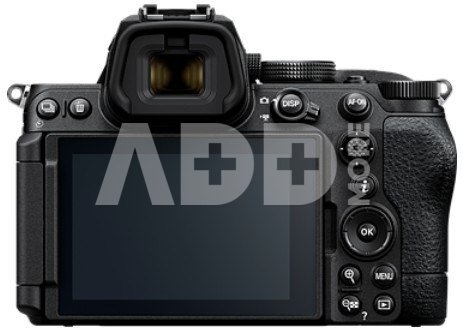
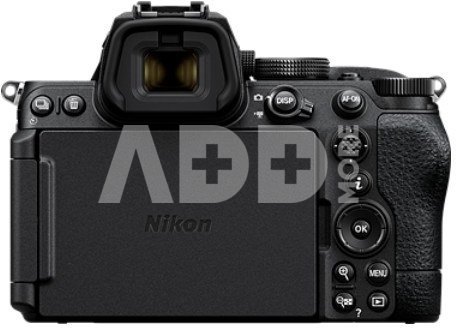
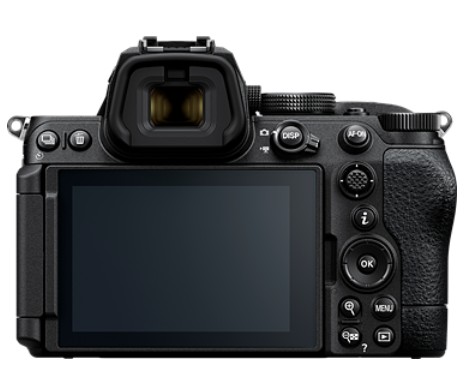
Monitor: 8cm/3.2in., approx. 2100k-dot vari-angle TFT touch-sensitive LCD with 170° viewing angle, approximately 100% frame coverage, and color balance and 15-level manual brightness controls
Shutter speed: ¹⁄₈₀₀₀ – 30 s (choose from step sizes of ¹⁄₃, ¹⁄₂, and 1 EV, extendable to 900 s in mode M), Bulb, Time
Self-timer: 2 s, 5 s, 10 s, 20 s; 1–9 exposures at intervals of 0.5, 1, 2, or 3 s
Exposure Mode: AUTO: auto, P: programmed auto with flexible program, S: shutter-priority auto, A: aperture-priority auto, M: manual
Exposure compensation: −5 – +5 EV (choose from step sizes of ¹⁄₃ and ¹⁄₂ EV)
ISO sensitivity (Recommended Exposure Index): ISO 100–64000 (choose from step sizes of ¹⁄₃ and 1 EV); can also be set to approx. 0.3, 0.7, or 1 EV (ISO 50 equivalent) below ISO 100 or to approx. 0.3, 0.7, 1, or 1.7 EV (ISO 204800 equivalent) above ISO 64000; auto ISO sensitivity control available. * Note: ISO sensitivity is limited to 400–64000 when HLG is selected for tone mode.
Autofocus type: Hybrid phase-detection/contrast AF with AF assist
Focus point*: 273 focus points (single-point AF), 299 focus points (auto-area AF). * Number of focus points available in photo mode with FX selected for image area
Video File format: NEV, MOV, MP4
Video Frame size (pixels) and frame rate (RAW video): [FX] 4032 × 2268: 30p/25p/24p. [DX] 3984 × 2240: 30p/25p/24p. * Actual frame rates for 30p, 25p, and 24p are 29.97, 25, and 23.976 fps respectively.
Audio recording device: Built-in stereo or external microphone can be used; sensitivity adjustable; attenuator, frequency response, and wind noise reduction functions
USB: Type-C SuperSpeed USB connector; connection to built-in USB ports is recommended
HDMI output: Type D HDMI connector
Audio input: Stereo mini-pin jack (3.5 mm diameter; plug-in power supported): Audio output/remote cord: Stereo mini-pin jack (3.5 mm diameter). The MC-DC3 remote cord can be used.. * The connector function can be set to either auto switch or fixed to headphones.
Battery: One EN‑EL15c rechargeable Li-ion battery *. * EN‑EL15b and EN‑EL15a batteries can be used in place of the EN‑EL15c. Note, however, that fewer pictures can be taken on a single charge than with the EN‑EL15c. EH-8P AC adapters can be used to charge EN‑EL15c and EN‑EL15b batteries only.
Dimensions (width x height x depth): approx. 134 × 100.5 × 72 mm (body only); lens dimensions (depth x length): approx. 73.5 mm x 51 mm (distance from camera lens mount flange Based on CIPA guidelines)
Weight: approx. 700 g (body with battery and memory card but without body cap and accessory shoe cover); approx. 620 g (camera body only); lens weight: approx. 195 g
Lens mount (bayonet)
Nikon Z mount
Image Sensor Size
Full frame (36 x 24 mm)
Maximum Resolution6048 × 4032
Discuss with a consultant in Kaunas
We don't haveKlaipėdaAddress: Birželio 23-iosios g. 23gWorking hours: I-V 09:00 - 18:00VI-VII not workingPhone: +370 674 59488
Discuss with a consultant in Klaipėda
We don't haveKlaipėdaAddress: Taikos pr. 17Working hours: I-V 10:00 - 19:00VI 10:00 - 14:00VII not workingPhone: +370 604 43972
1. Which mirrorless camera should I choose for better photo results?
Choosing the right mirrorless camera for better photo results depends on your individual needs and budget. The Sony Alpha a7 III is a popular choice, offering excellent dynamic range and efficient autofocus. The Canon EOS R6 also boasts high technical performance, including powerful image stabilisation. The Nikon Z6 II is another attractive choice with excellent dynamic range and high ISO sensitivity. It's important to consider the features of each model, the choice of lenses and the ability to suit your shooting style. It is recommended to read reviews and test equipment before buying, if possible.
2. What are the advantages of mirrorless cameras compared to DSLR cameras?
The advantages of mirrorless cameras over DSLR cameras include modern technology and lightness. Mirrorless cameras are more compact and lighter, making them more comfortable to carry. They often have a smaller body because they do not have a mirror system, which reduces the overall weight. The use of an electronic viewfinder allows the actual frame to be seen before the picture is taken, thus optimising composition and exposure. Mirrorless cameras have fast autofocus and some models may perform better in low light conditions. They also offer more creative options, including a range of filters and effects. The new generation of lenses offers improved performance and efficiency, contributing to higher quality photos. However, every photographer's needs are different, so it is important to consider your preferences carefully before choosing a camera.
The website uses cookies, which help you ensure quality of service. Continuing browsing, you agree with fotoaparatas.eu cookies policy.Agree

















Reviews
0 average rating (0 votes)