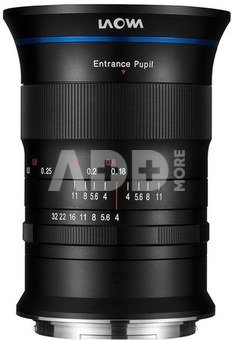
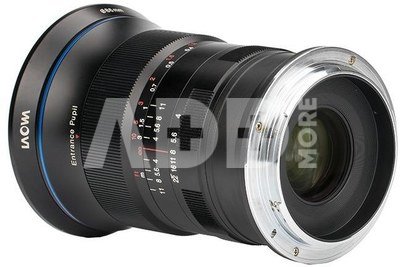
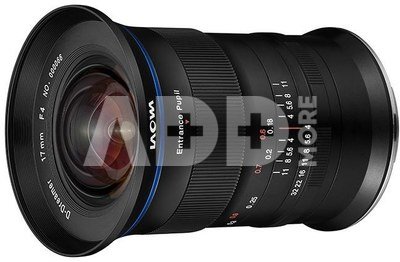
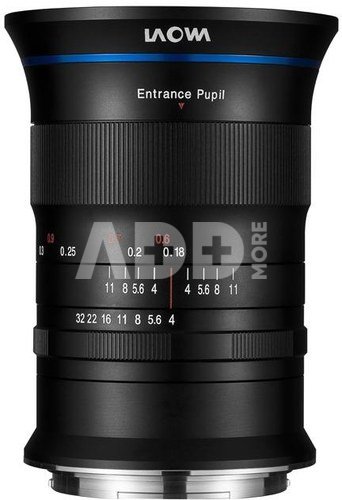
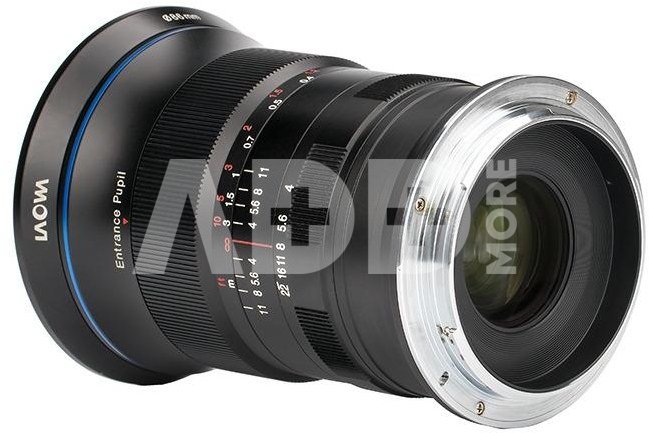
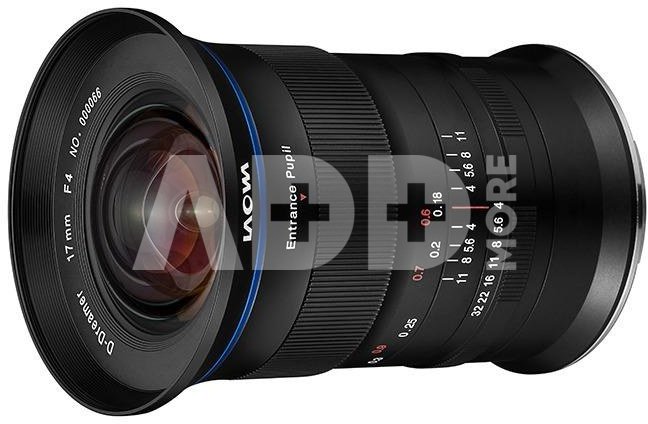
Laowa D-Dreamer 17 mm f/4,0 Zero-D for Fujifilm G
The Ultra-wide angle FoV, with Close-to-Zero distortion (Zero-D), makes it perfect for landscape, architecture, interior and astrophotography. The 113° angle of view enables photographers to include more into the frame. The 86mm filter thread allows quick attachment of filters for maximum creativity under different light conditions. The lens also features a 5-blade aperture system for creating pleasing sun-star renderings (10-point stars). The Laowa 17mm f/4 GFX Zero-D is currently the widest native lens for Fujifilm GFX cameras. Featuring a 113° angle of view, the lens is ideal for various types of photography including landscape, interior, architecture and astrophotography. Due to the 0.79x “crop” factor of the medium format-sized sensor of GFX cameras, the angle of view is equivalent to a 13mm lens on a 35mm format sensor. It is extremely helpful when shooting interiors or in tight spaces. More information and details can now be included in the frame, compared to any other wide angle lens on the market. © Jonas Rask © Bryan Minear © Christian Ringer © Jonas Rask © Jonas Rask © Jonas Rask © Bryan Minear © Louis Ferreira © Bryan Minear © Christian Ringer © Christian Ringer © Bryan Minear Comprised of 21 elements in 14 groups, the new 17mm f/4 lens is the 4th member of the Laowa “Zero-D” product line-up, which exhibits close-to-zero optical distortion. This particular feature is extremely useful for architecture and interior photographers as all the straight lines can now be retained. © Bryan Minear © Louis Ferreira © Louis Ferreira © Qin Fei Despite the ultra-wide angle of view, LAOWA has managed to incorporate an 86mm front filter thread. Photographers can quickly attach screw-on filters for maximum control and creativity under different lighting conditions. 86mm Filter Thread Photographers can also choose to add a magnetic filter holder to use with 100mm-wide filters. A maximum of 2 filters can be stacked with no vignetting visible at any rotation angles. Magnetic Filter Holder for 100mm-wide filters The 5-blade aperture system produces a pleasing sunstar rendering. By stopping down the aperture, a photographer can easily create perfect 10-point sunstars. © Dylan Goldby © Dylan Goldby © Bryan Minear Similar to other Laowa wide angle lenses, the new 17mm f/4 has impressive close-focusing capabilities! It can focus only 7.9”/ 20cm from the sensor. This allows photographers to get extremely close to the subject while still being able to include the background information in the scene. © Dylan Goldby © Jonas Rask The Laowa 17mm f/4 can achieve amazing high resolution results at both the centre and edge of the frame. Details at the edges are well preserved even on the 102MP sensor of GFX 100 cameras. © Dylan Goldby There is no other native G mount lens that can achieve the same perspective as the Laowa 17mm f/4 GFX lens. The Canon TS-E 17mm f/4L has been used (together with an adapter) for such purposes, due to the enlarged image circle of a shift lens. We have therefore run a sharpness comparison between the new Laowa 17mm f/4 and the Canon TS-E 17mm f/4L, using a Fujifilm GFX50S body. All un-modified images were shot at ISO 100 and f/11. You can clearly see the Laowa 17mm f/4’s superior performance and details in all parts of the frame. All shot at Iso 100 and f/11. © Cloud Photography
Discuss with a consultant in Kaunas
We don't have
Klaipėda Address: Birželio 23-iosios g. 23g Working hours: I-V 09:00 - 18:00 VI-VII not working Phone: +370 674 59488
Discuss with a consultant in Klaipėda
We don't have
Klaipėda Address: Taikos pr. 17 Working hours: I-V 10:00 - 19:00 VI 10:00 - 14:00 VII not working Phone: +370 604 43972
1. How to choose the right lens for a mirrorless camera?
When choosing the right lens for a mirrorless camera, it is important to consider your photography needs and style. First, decide on the resolution and focusing distance you require. For portraits, lenses with a wide aperture, such as a 50mm f/1.8, are often preferred. If you enjoy landscapes, go for a wide-angle lens (e.g., 24mm). To capture distant objects, telephoto lenses (e.g., 70-200mm) are useful. Another important factor is the lens’s light-gathering ability, which affects performance in low-light conditions. A stabilization system can also be important, especially for longer lenses. It’s important to evaluate the build quality of the lens and the manufacturer's reputation. Try out several lenses and consider your future needs to choose the right and long-lasting investment in your photography.
2. Are all lenses compatible with all mirrorless cameras?
Not all lenses are universal for all mirrorless cameras. Different manufacturers may have different mounts, so it is important to check the lens compatibility with your camera. For example, lenses for Canon, Nikon, Sony, and other manufacturers' mirrorless cameras may not be interchangeable without adapters. It is also important to consider the sensor size. APS-C lenses may be disproportionately large for full-frame cameras. Before purchasing a lens, it is advisable to check the manufacturer's compatibility chart and consider the specific requirements of your camera. Adapters can allow the use of third-party lenses, but there may be some loss in functionality or quality.

















Reviews
0 average rating (0 votes)